
Expert Cervical Myelopathy Treatment in Bangalore
If you're noticing clumsy hands, unsteady walking, tingling in your arms or legs, or trouble with fine tasks like buttoning a shirt, you may be dealing with cervical myelopathy — compression of the spinal cord in the neck. It's a progressive condition, and the earlier it's caught, the better the outcome. Dr. Ramachandran Govindasamy, a leading spine surgeon in Bangalore, offers dynamic-MRI-guided, evidence-based Cervical Myelopathy treatment in Bangalore.
Cervical myelopathy is caused by spinal cord compression in the neck, most often from age-related cervical spondylosis. Mild cases can be managed with a cervical collar and targeted physiotherapy, while moderate-to-severe cases with weakness, gait changes, or bladder involvement usually need decompression surgery (laminoplasty, laminectomy, or ACDF) to prevent permanent nerve damage. Early diagnosis significantly improves recovery.
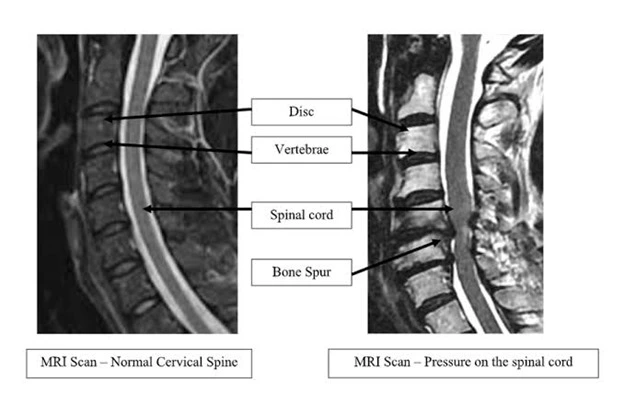
What Is Cervical Myelopathy?
Cervical myelopathy is compression of the spinal cord within the neck (cervical spine). Unlike simple neck pain, it affects the signals traveling between the brain and the rest of the body — which is why symptoms often show up in the hands, legs, and balance rather than the neck itself. It's one of the most common causes of spinal cord dysfunction in adults over 50, and it can worsen silently if left untreated, making early recognition critical.
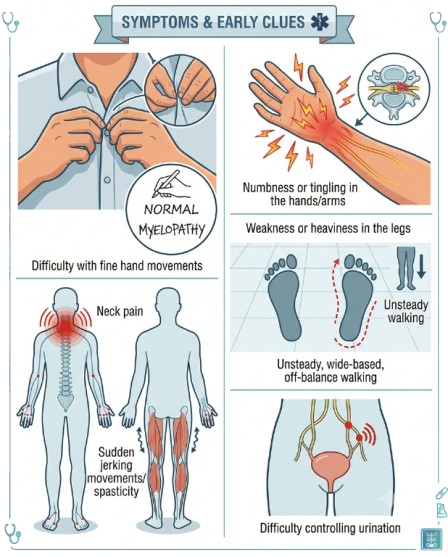
Symptoms of Cervical Myelopathy You Shouldn't Ignore
Cervical myelopathy develops gradually, and symptoms are often mistaken for normal aging or minor clumsiness. Watch for:
- Weakness in the legs or a feeling of heaviness when walking
- Difficulty with fine hand movements — buttoning shirts, writing, using keys or a phone
- Numbness or tingling in the hands, arms, or legs
- Unsteady, wide-based, or “off-balance” walking
- Sudden jerking movements in the legs, even at rest (spasticity)
- Difficulty controlling urination in more advanced cases
- Neck pain — may or may not be present, depending on the underlying cause
Early clues like hand numbness or a noticeable change in handwriting are especially important — catching these early allows for less invasive treatment and better recovery.
How Severe Is It? — Clinical Assessment
Doctors grade cervical myelopathy using standardized clinical scales that assess motor function, sensation, gait, and bladder control. This grading helps determine:
- How advanced the compression is
- Whether non-surgical management is appropriate or surgery is needed
- What kind of recovery to expect after treatment
Common Causes of Cervical Myelopathy
| Cause | Details |
|---|---|
| Cervical spondylosis | The most common cause — age-related wear and tear of the neck bones and discs, typically in patients in their 60s |
| OPLL (Ossified Posterior Longitudinal Ligament) | A ligament behind the spinal canal hardens/calcifies and compresses the cord |
| OYLL (Ossified Yellow Ligament) | Similar calcification of the ligamentum flavum, narrowing the spinal canal |
| Inflammatory conditions | E.g., Ankylosing spondylitis |
| Spinal tumors | Growths within or near the cervical spinal canal |
| Cervical spine infections | Infections that produce compressive myelopathy |
People between 30–50 years with specific congenital or inflammatory bone conditions, and those in their 60s with cervical spondylosis, are at higher risk.
Treatment Options for Cervical Myelopathy in Bangalore
Non-Surgical Management (Mild Cases)
For less advanced cases, treatment focuses on protecting the spinal cord from further compression and strengthening supporting structures:
- Cervical collar/brace for support and stabilization
- Targeted physiotherapy and posture correction exercises
- Regular monitoring with clinical assessment and imaging
Surgical Treatment (Moderate-to-Severe Cases)
When compression is significant or symptoms are progressing, surgery relieves pressure on the spinal cord. The right procedure depends on the exact cause, number of levels involved, and the natural curve of the neck:
- Cervical Laminoplasty — reshapes the vertebral arch to create more room for the cord while preserving neck motion
- Cervical Laminectomy — removes the back part of the vertebra to decompress the spinal cord
- Anterior Cervical Discectomy & Fusion (ACDF) — removes the compressing disc from the front of the neck and fuses the segment for stability
Dr. Ramachandran's Diagnostic Approach
Most clinics rely on standard MRI alone. Dr. Ramachandran goes further, using dynamic MRI — imaging the neck in flexion and extension — to reveal compression that only appears during movement and is missed on a routine static scan. This detailed picture allows him to:
- Pinpoint the exact cause and level(s) of compression
- Choose the most appropriate procedure (Laminoplasty, Laminectomy, or ACDF) with precision
- Reduce the risk of missed diagnosis or repeat surgery
- Improve long-term outcomes and prevent recurrence
Why this matters:
Choosing the wrong surgical approach for cervical myelopathy can lead to incomplete decompression or recurrent symptoms. Dynamic MRI-guided planning is a key differentiator in Dr. Ramachandran's practice.
- 14+ years of dedicated spine surgery experience
- Dynamic MRI-based, evidence-driven surgical planning
- Both non-surgical and minimally invasive surgical options
- Available across multiple Bangalore locations: Whitefield, Kasavanahalli
FAQs
Cervical myelopathy is compression of the spinal cord in the neck, most commonly caused by age-related wear and tear (cervical spondylosis). It disrupts the nerve signals between the brain and body, leading to weakness, numbness, and coordination problems. Early signs often include hand clumsiness (like difficulty buttoning a shirt or handwriting changes), numbness or tingling in the hands, and mild balance issues while walking. Neck pain may or may not be present. Yes. Left untreated, it can progressively worsen, leading to significant weakness, an unsteady gait, and loss of bladder control. Early diagnosis and treatment greatly improve the chances of a full recovery. Mild cases can sometimes be managed with a cervical collar, physiotherapy, and close monitoring. However, moderate-to-severe cases — especially with progressive weakness or bladder involvement — typically require surgical decompression to prevent permanent nerve damage. Depending on the cause and location of compression, surgery may involve Cervical Laminoplasty, Cervical Laminectomy, or Anterior Cervical Discectomy & Fusion (ACDF). The choice depends on detailed imaging findings, including dynamic MRI. A dynamic MRI images the neck while it moves (flexion and extension), revealing spinal cord compression that a standard, static MRI can miss. This helps in accurately selecting the right surgical approach. People in their 60s with cervical spondylosis, and people aged 30–50 with conditions like OPLL, OYLL, or ankylosing spondylitis, are at higher risk. Spinal tumors and infections can also cause compressive myelopathy. No. Neck pain may or may not be present. Many patients present primarily with hand clumsiness, gait changes, or limb numbness rather than neck pain, which is why the condition is sometimes missed early. Dr. Ramachandran Govindasamy provides dynamic MRI-guided, evidence-based cervical myelopathy treatment at Spine DRx Clinics in Whitefield and Kasavanahalli, Bangalore.What is Cervical myelopathy?
What are the first signs of cervical myelopathy?
Is cervical myelopathy serious?
Can cervical myelopathy be treated without surgery?
What surgery is used to treat cervical myelopathy?
What is a dynamic MRI, and why is it used for cervical myelopathy?
Who is at risk of cervical myelopathy?
Does cervical myelopathy always cause neck pain?
Where can I get expert cervical myelopathy treatment in Bangalore?
Book a Consultation for Cervical Myelopathy in Bangalore
Don't dismiss hand clumsiness, tingling, or balance changes as “just aging.” Early diagnosis of cervical myelopathy can prevent permanent nerve damage and avoid more extensive surgery later.