
Anterior Cervical Discectomy and Fusion (ACDF) in Bangalore — SpineDRx
Are you living with persistent neck pain that shoots down your arm? Do you experience numbness, tingling, or weakness in your hands? Have you been diagnosed with a cervical disc prolapse, cervical spondylosis, or cervical myelopathy that has failed to respond to months of physiotherapy and medication?
Anterior Cervical Discectomy and Fusion (ACDF) is one of the most commonly performed and reliably successful procedures in spinal surgery — and at SpineDRx, Bangalore, it is performed by Dr. Ramachandran Govindasamy using a microscope, intraoperative neuromonitoring (IONM), and proven implant systems, with most patients walking home the same day or the following morning.
This page explains everything you need to know about ACDF surgery in Bangalore — what it is, why it is done, how it is performed, what to expect during recovery, and how to decide if it is right for you.
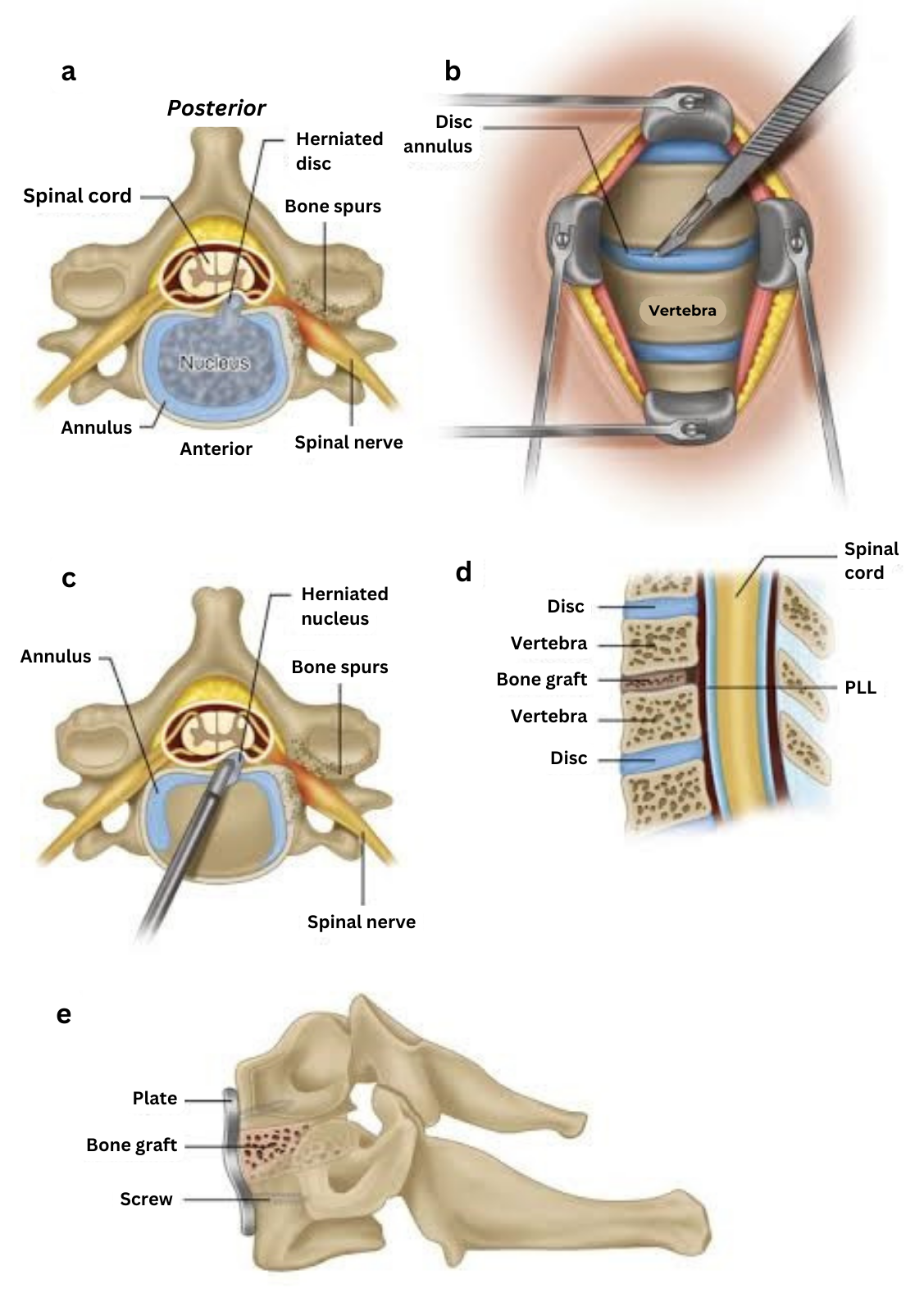
What Is ACDF? — A Plain-Language Explanation
ACDF stands for Anterior Cervical Discectomy and Fusion. Let's break the name down:
Anterior
The approach is made from the front (anterior) of the neck — through a small horizontal incision in the skin crease — rather than from the back. This avoids cutting any muscles and gives direct access to the cervical discs.
Cervical
The operation is performed on the cervical spine — the seven vertebrae (C1 to C7) that make up the neck.
Discectomy
The damaged or prolapsed intervertebral disc is completely removed (discectomy) — including the nucleus pulposus and the cartilage endplates — to decompress the spinal cord and nerve roots fully.
Fusion
Once the disc is removed, the empty disc space is filled with an implant — either a cage packed with bone graft or a standalone titanium implant — and a plate is fixed across the adjacent vertebrae. Over the following months, new bone grows across the disc space, permanently fusing the two vertebrae into one solid unit.
The result: the pressure on the nerve or spinal cord is completely relieved, the neck is stabilised, and the nerve has space to heal — leading to resolution of arm pain, tingling, weakness, and in many cases, significant improvement in neck pain.
Why Is ACDF Surgery Needed? — Conditions Treated
ACDF is indicated when cervical spinal pathology is causing nerve root compression (radiculopathy) or spinal cord compression (myelopathy), and conservative measures have failed or the situation is neurologically urgent. The most common conditions requiring ACDF in Bangalore include:
| Condition | What Happens | Main Symptoms |
|---|---|---|
| Cervical Disc Prolapse (Soft Disc Herniation) | Inner disc material (nucleus) ruptures outward and presses on a nerve root or the spinal cord. | Arm pain (brachialgia), tingling or numbness in fingers, hand weakness. |
| Cervical Spondylosis with Radiculopathy | Age-related disc degeneration and bone spur (osteophyte) formation compress nerve roots at one or more levels. | Chronic neck pain, electric-shock arm pain, finger numbness, grip weakness. |
| Cervical Myelopathy | Disc or bone spurs compress the spinal cord itself, making it the most serious cervical condition. | Clumsy hands, balance problems, leg weakness, gait disturbance, bladder urgency. |
| Cervical Disc Osteophyte Complex | Hard calcified disc material fused with bone spurs causes rigid spinal cord or nerve compression. | Symptoms similar to myelopathy or radiculopathy, often more severe and slower to develop. |
| Traumatic Cervical Disc Herniation | Acute disc rupture resulting from a road accident, fall, or sports injury. | Sudden severe neck and arm pain, possible acute neurological deficit. |
| Cervical Instability / Listhesis | Abnormal slipping of one vertebra over another causes instability and neural compression. | Neck pain with movement, arm pain, myelopathy symptoms. |
Who Needs ACDF? — Indications and Decision-Making
Not every patient with a cervical disc prolapse needs surgery. Dr. Ramachandran recommends ACDF only when the clinical situation clearly justifies it. The key indications are:
Absolute Indications (Surgery Should Not Be Delayed):
- Cervical myelopathy (spinal cord compression) — hand clumsiness, gait disturbance, bladder symptoms; delay risks permanent cord damage
- Progressive neurological deficit — worsening weakness or paralysis of the arm or hand despite conservative treatment
- Acute severe disc herniation with dense neurological deficit
- Cervical fracture-dislocation with instability and neural compression
Relative Indications (Surgery Considered After Conservative Failure):
- Radiculopathy (arm pain/tingling) that has not responded to 6–12 weeks of physiotherapy, medications, and cervical epidural injections
- Significant pain and disability affecting work and quality of life despite adequate conservative treatment
- Large disc herniation with severe neural compression on MRI correlating with the patient's symptoms
- Recurrent episodes of severe radiculopathy significantly impacting daily function
Dr. Ramachandran's philosophy: surgery is a tool to be used when its benefits clearly outweigh the risks for that individual patient — never as a first resort, and always with the patient's informed consent and full understanding.
Single-Level vs. Multi-Level ACDF — What's the Difference?
Many episodes of mechanical back and neck pain resolve on their own within a few weeks. However, you should consult a spine specialist immediately if you experience any of the following:
| Feature | Single-Level ACDF | Multi-Level ACDF (2–4 Levels) |
|---|---|---|
| Levels Fused | One disc space (e.g., C5-C6) | Two to four disc spaces (e.g., C4-C5, C5-C6, C6-C7) |
| Operation Time | 60–90 minutes | 2–3.5 hours |
| Hospital Stay | Same-day discharge or overnight stay | Typically 1–2 days |
| Recovery | 2–4 weeks to resume light activities | 4–6 weeks to resume light activities |
| Fusion Rate | 95–98% | 85–95% (slightly lower with each additional level) |
| Neck Movement | Minimal loss of motion at one segment | Moderate reduction in overall range of motion |
| Main Indication | Single-level disc prolapse or cervical spondylosis | Multi-level cervical myelopathy or radiculopathy |
How Is ACDF Performed? — Step-by-Step at SpineDRx
Step 1: Anaesthesia and Positioning
The patient is placed supine (lying on their back) under general anaesthesia. The neck is gently extended with a shoulder roll to improve access. Baseline IONM (intraoperative neuromonitoring — SSEP and MEP) readings are established after induction to monitor spinal cord function throughout the procedure.
Step 2: The Anterior Approach — No Muscle Cutting
A small horizontal incision (typically 3–5 cm) is made in a natural skin crease on the right or left side of the neck. The approach is developed between the carotid artery (and sternocleidomastoid muscle) on one side and the trachea and oesophagus on the other — this is an entirely natural tissue plane with no muscle cutting. The prevertebral fascia is then opened to expose the front of the cervical spine.
Step 3: Fluoroscopic Level Confirmation
Before removing any disc material, Dr. Ramachandran confirms the operative level using intraoperative fluoroscopy (X-ray) by inserting a small needle into the disc space. This critical safety step eliminates any risk of operating at the wrong level.
Step 4: Microscopic Discectomy
Operating under high magnification with the surgical microscope, the entire disc is meticulously removed — including the cartilage endplates on both the upper and lower vertebrae. Bone spurs (osteophytes) pressing on the nerve root or spinal cord are removed using high-speed drills and fine curettes. The posterior longitudinal ligament (PLL) is opened if necessary to access any disc fragments that have migrated behind the vertebral body. The result is a completely decompressed spinal cord and nerve root — confirmed visually under the microscope.
Step 5: Cage and Plate Fixation
The disc space is measured and a precisely sized cage — made of PEEK (polyetheretherketone) or titanium — packed with bone graft or synthetic bone substitute is inserted to restore disc height and cervical lordosis. An anterior cervical plate with screws is then fixed across the operated level(s) to provide immediate stability, protect the cage, and enhance the rate of fusion. The plate also prevents cage migration — a key safety advantage.
Step 6: Wound Closure and Discharge
The wound is closed in layers with absorbable sutures. A drain may be placed for multilevel surgery. Most single-level ACDF patients at SpineDRx are discharged on the same day or the morning after surgery. A soft cervical collar is provided for 4–6 weeks for comfort and healing support.
ACDF vs. Cervical Disc Replacement (CDR) vs. Posterior Approaches — Which Is Right for You?
ACDF is not the only surgical option for cervical disc disease. Dr. Ramachandran evaluates each patient's MRI, age, cervical alignment, and pathology to determine the best approach.
| Feature | ACDF | Cervical Disc Replacement (CDR) | Posterior Foraminotomy |
|---|---|---|---|
| Approach | Front of neck | Front of neck | Back of neck |
| Disc Removed? | Yes — full discectomy | Yes — full discectomy | No — partial disc removal only |
| Fusion | Yes — permanent fusion | No — motion preserved | No — motion preserved |
| Best For | All cervical disc pathology, myelopathy, and multi-level disease | Single-level soft disc herniation in young, active patients with normal cervical lordosis | Lateral disc herniation or foraminal stenosis without axial neck pain or myelopathy |
| Adjacent Segment Risk | Slightly higher in the long term | Lower due to preserved motion | Lower due to preserved motion |
| Gold Standard for Myelopathy? | Yes | Not indicated | No |
Dr. Ramachandran discusses all surgical options with each patient before the decision is made. The goal is always the most effective operation with the least impact on neck mobility and the lowest long-term complication risk for that individual.
FAQs
ACDF stands for Anterior Cervical Discectomy and Fusion. It is a surgical procedure performed through the front (anterior) of the neck to remove a damaged or prolapsed cervical disc that is compressing a nerve root or the spinal cord. Once the disc is removed, the empty space is filled with a cage and bone graft, and a plate is fixed across the vertebrae to stabilise the spine. Over 3–12 months, the two vertebrae fuse into one solid unit. The procedure relieves arm pain, tingling, numbness, and weakness caused by nerve or cord compression. ACDF is one of the most extensively studied and reliably safe operations in spinal surgery, with over 50 years of published outcomes data. The overall complication rate is low. Common temporary side effects include mild throat soreness and hoarseness, which resolve within 1–2 weeks. Serious complications such as nerve injury or spinal cord damage are extremely rare — especially when surgery is performed under a surgical microscope with intraoperative neuromonitoring (IONM), as at SpineDRx. Dr. Ramachandran discusses all risks thoroughly during the pre-surgical consultation. Yes — for most single-level ACDF procedures at SpineDRx, patients are walking within 2–3 hours of surgery and are discharged the same evening. Multi-level ACDF patients typically stay 1–2 nights. The ability to go home quickly depends on recovery from anaesthesia, adequate pain control on oral medications, and the absence of any early complications. Dr. Ramachandran's same-day discharge protocol has been applied safely to single-level ACDF patients with excellent outcomes. Most patients return to desk work and light activities within 3–6 weeks after ACDF. Arm pain typically improves within days to weeks. Tingling and numbness improve over weeks to months as the nerve heals. Driving is usually resumed at 6–8 weeks when neck rotation is comfortable. Full solid fusion is confirmed on X-ray at 12–18 months. Physical and manual work return timelines depend on the job — discussed individually with Dr. Ramachandran. Fusing one level (e.g., C5-C6) results in minimal, often unnoticeable loss of neck movement in daily life. The adjacent levels compensate well. Multi-level fusion (2–3 levels) does produce a more noticeable reduction in neck range of motion — something Dr. Ramachandran discusses carefully during pre-surgical planning. Cervical disc replacement (CDR) is an alternative that preserves motion at a single level — suitable for selected young, active patients. The best option for each patient is determined by MRI findings, cervical alignment, and clinical presentation. Both ACDF and cervical disc replacement (CDR) involve removing the damaged disc from the front of the neck. In ACDF, the disc space is filled with a cage and fused permanently. In CDR, an artificial disc implant is inserted to preserve motion at that level. CDR is best suited for single-level soft disc herniation in younger, active patients with preserved cervical lordosis and no significant facet arthritis. ACDF remains the gold standard for multi-level disease, cervical myelopathy, instability, and when bone spurs (hard disc) are the cause of compression. Dr. Ramachandran offers both procedures and selects the most appropriate one for each patient. Dr. Ramachandran Govindasamy at SpineDRx, Bangalore, is an experienced cervical spine surgeon with specialised training in anterior cervical surgery. He performs ACDF using a surgical microscope and intraoperative neuromonitoring for maximum safety and precision. He is available at his clinics in Kasavanahalli and Whitefield, and at Aster Whitefield Hospital, Bangalore. Appointments can be booked at spinedrx.com/contact-us/. Posterior cervical approaches (laminoplasty, laminectomy, posterior foraminotomy) are preferred over ACDF when: there are more than 3–4 levels of compression, the compression is primarily from the back of the spine, there is significant OPLL (ossification of the posterior longitudinal ligament) across multiple levels, or when the patient has a pre-existing fused anterior construct and surgery is needed at adjacent levels. Dr. Ramachandran assesses each patient's MRI, CT, and clinical picture to recommend the correct approach — he offers all cervical surgical approaches, both anterior and posterior. The cost of ACDF surgery in Bangalore at SpineDRx varies based on the number of levels being operated, the implant system chosen (cage and plate type), and the hospital facility charges. Single-level ACDF is significantly less expensive than multi-level surgery. Most health insurance policies in India cover ACDF when medically indicated. A detailed, transparent cost breakdown is provided at the pre-surgical consultation. Please contact SpineDRx on 7996997989 / 9902290933 for personalised cost information. Physiotherapy, anti-inflammatory medications, and cervical epidural injections are always the first line of treatment for cervical disc disease with radiculopathy — and many patients improve without needing surgery. However, when there is cervical myelopathy (spinal cord compression), progressive neurological deficit, or persistent disabling radiculopathy that has not responded to 6–12 weeks of conservative management, ACDF produces superior and more predictable outcomes than continued non-surgical treatment. Dr. Ramachandran always ensures appropriate conservative measures are exhausted before recommending surgery, except in cases of urgent neurological compromise.Q1. What is ACDF surgery and how does it work?
Q2. Is ACDF surgery safe? What are the risks?
Q3. Can I go home the same day after ACDF surgery?
Q4. How long does recovery from ACDF take?
Q5. Will I lose neck movement after ACDF?
Q6. What is the difference between ACDF and cervical disc replacement?
Q7. Which doctor performs ACDF surgery in Bangalore?
Q8. When should I avoid ACDF and consider a posterior approach instead?
Q9. How much does ACDF surgery cost in Bangalore?
Q10. Is ACDF better than physiotherapy for cervical disc disease?
What Happens If Cervical Disc Disease Is Left Untreated?
Ignoring cervical myelopathy or progressive radiculopathy can have serious, sometimes irreversible consequences:
Permanent Nerve Damage
Prolonged compression of a cervical nerve root can lead to irreversible numbness, weakness, or loss of function in the arm and hand.
Spinal Cord Injury
Untreated cervical myelopathy may progress to permanent spinal cord damage, causing severe weakness or paralysis of all four limbs (quadriparesis).
Worsening Functional Decline
Patients may experience increasing difficulty with hand coordination, balance, walking, and bladder or bowel control over time.
Chronic Pain
Persistent nerve compression can lead to chronic neuropathic pain syndromes that may require long-term pain management.
Falls and Injury
Balance problems and gait disturbances caused by cervical myelopathy significantly increase the risk of falls and related injuries.
The most important principle: for cervical myelopathy, earlier surgery produces better outcomes. Do not delay evaluation if you have hand clumsiness, balance problems, or leg weakness.
Book Your ACDF Consultation in Bangalore
Neck pain that shoots down your arm, tingling fingers, or a clumsy hand are not problems you have to endure. Expert evaluation at SpineDRx will determine whether your symptoms are due to cervical disc disease, what level is involved, and whether surgery — or further conservative management — is the right next step for you.
Call : 7996997989 | 7996992919 | 9902290933