
Lumbar Fusion Surgery in Bangalore
Including Minimally Invasive Lumbar Fusion Surgery (MIS-TLIF)
When chronic back pain comes from an unstable, slipped or degenerated spine, lumbar fusion surgery stabilises the affected vertebrae and relieves nerve compression. Dr. Ramachandran Govindasamy performs both traditional and minimally invasive lumbar fusion surgery in Bangalore, using navigation and robotic-guided screw placement for precision and a faster recovery.
4+
Fusion Approaches Offered
1 Day
Typical Time to Standing & Walking
14+
Years Spine Surgery Experience
3
Bangalore clinic locations
What is Lumbar Fusion Surgery?
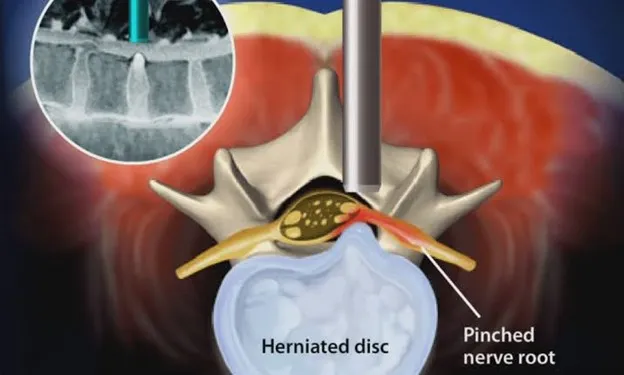
Lumbar fusion surgery, also called lumbar interbody fusion, is a spinal procedure recommended for conditions that have not responded to medical treatment — including spondylolisthesis, disc prolapse, degenerative disc disease and scoliosis. The damaged disc between two vertebrae is removed and replaced with the patient's own bone or an interbody cage to encourage the two vertebrae to fuse into a single, stable segment.
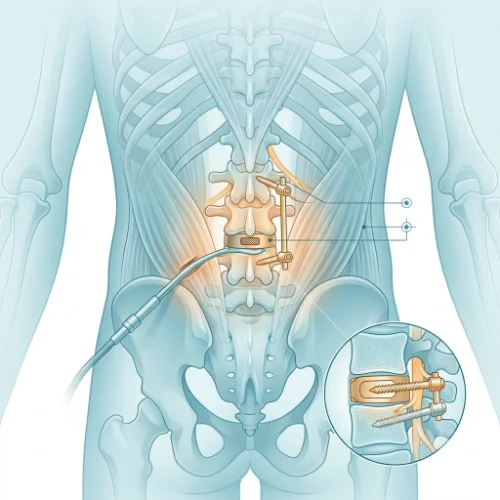
To support healing and provide immediate stability, pedicle screws are inserted — under navigation or robotic guidance — and connected with rods. This restores stability to the spine and relieves pressure on compressed nerves.
Minimally Invasive Lumbar Fusion Surgery in Bangalore
Minimally invasive lumbar fusion surgery (MIS-TLIF) achieves the same goal — decompression, disc replacement and stabilisation — through small incisions and tubular retractors instead of a long midline incision. Guided by real-time navigation and, where indicated, robotic assistance, the surgeon places the interbody cage and pedicle screws with precision while working around the muscle rather than through it.
For patients in Bangalore considering their options, this generally means less blood loss, less post-operative pain, a shorter hospital stay, and a quicker, brace-free return to sitting, standing and walking compared with open lumbar fusion surgery.
Approaches to Lumbar Interbody Fusion
Dr. Ramachandran is proficient in all approaches to lumbar fusion, and selects the technique best suited to each patient's anatomy and condition.
| Approach | Access Route | Best Suited For | Invasiveness |
|---|---|---|---|
| TLIF / PLIF Posterior Lumbar Fusion |
From the back | Spondylolisthesis, degenerative disc disease, single or multi-level disease | Open |
| MIS-TLIF Minimally Invasive Lumbar Fusion |
From the back, via tubular retractor | Same indications as TLIF, in suitable candidates seeking faster recovery | Minimally invasive |
| OLIF / XLIF Lateral Lumbar Interbody Fusion |
From the side | Degenerative disc disease, adult spinal deformity, indirect decompression | Minimally invasive |
| ALIF Anterior Lumbar Interbody Fusion |
From the front (abdomen) | L5–S1 disease, revision surgery, larger cage placement for correction | Open / mini-open |
Who Needs This Surgery
Conditions Treated with Lumbar Fusion Surgery
Benefits of Minimally Invasive Lumbar Fusion Surgery
Precision
Navigation & robotic guidance
Pedicle screws are placed with image-guided accuracy, reducing the margin for error.
Recovery
Brace-free mobility
Most patients walk, sit, bend and climb stairs without external braces soon after surgery.
Trauma
Less muscle disruption
Tubular access preserves surrounding muscle compared with a long open incision.
Trauma
Reduced blood loss
Smaller exposure means less bleeding during surgery.
Stay
Shorter hospital stay
Faster early mobilisation often translates to fewer days in hospital.
Function
Quicker return to activity
Patients typically resume daily routines sooner than with open fusion.
The Procedure
How Lumbar Fusion Surgery Is Performed
1. Evaluation & Imaging
Clinical assessment with X-ray, MRI or CT to confirm the diagnosis and plan the right approach and levels.
2. Anaesthesia & Positioning
A precise incision of approximately one inch is made over the affected disc level, minimizing disruption to surrounding muscle.
3. Approach-Specific Access
A small tubular incision (MIS-TLIF) or an open approach is used to reach the affected disc space.
4. Disc Removal & Cage Placement
The damaged disc is removed and replaced with a bone graft or interbody cage to restore disc height and promote fusion.
5. Navigation / Robotic-Guided Fixation
Pedicle screws and rods are placed under image guidance to stabilise the fused segment.
6. Closure & Early Mobilisation
The incision is closed and, in most cases, the patient is guided to sit and stand within a day.
What to Expect After Surgery
Day 1
Assisted standing and walking; pain managed with medication.
Days 3–5
Hospital discharge for most patients; gradual increase in walking distance.
Week 4–6
Return to light daily activities; physiotherapy as advised.
Month 3–6
Progressive fusion consolidation; return to most normal activities as guided.
Lumbar Fusion Surgery in Bangalore, Led by Dr. Ramachandran Govindasamy
Dr. Ramachandran Govindasamy is a Consultant Spine & Deformity Surgeon with over 14 years of experience and training from premier institutes across India, the USA, Germany, Denmark and Malaysia. He is proficient in all approaches to lumbar fusion — TLIF/PLIF, MIS-TLIF, OLIF/XLIF and ALIF — and uses navigation and robotic guidance to place every screw with precision.
His approach focuses on getting patients back on their feet: most patients are able to walk, sit, bend and climb stairs without external braces immediately after surgery, resuming daily activities without unnecessary delay.
FAQs
Traditional (open) lumbar fusion surgery — such as TLIF, PLIF or ALIF — uses a larger incision to directly access the spine. Minimally invasive lumbar fusion surgery (MIS-TLIF) uses small incisions, tubular retractors and navigation or robotic guidance to reach the same disc space with far less disruption to surrounding muscle, typically meaning less blood loss, less post-operative pain, and a faster return to daily activity. Lumbar fusion is generally recommended when conditions such as spondylolisthesis, recurrent disc prolapse, degenerative disc disease, spinal instability or scoliosis have not responded to medical treatment, physiotherapy or injections, and are causing persistent back or leg pain. Because MIS-TLIF is performed through small incisions with minimal muscle disruption, patients generally experience significantly less post-operative pain than with open lumbar fusion surgery, and pain is well controlled with medication in the days following surgery. Operating time depends on the number of spinal levels involved and the approach used, typically ranging from about two to four hours for a single or two-level fusion. Your surgeon will give you a time estimate specific to your case. With navigation and robotic-guided fixation, most patients are able to walk, sit, bend and climb stairs without external braces within a day of surgery. Cost varies depending on the surgical approach, number of spinal levels involved, implants used, and the hospital. Book a consultation with Dr. Ramachandran Govindasamy at SpineDRX for a personalised evaluation and cost estimate.What is the difference between lumbar fusion surgery and minimally invasive lumbar fusion surgery?
Who needs lumbar fusion surgery?
Is minimally invasive lumbar fusion surgery painful?
How long does lumbar fusion surgery take?
How soon can I walk after lumbar fusion surgery?
What is the cost of lumbar fusion surgery in Bangalore?