
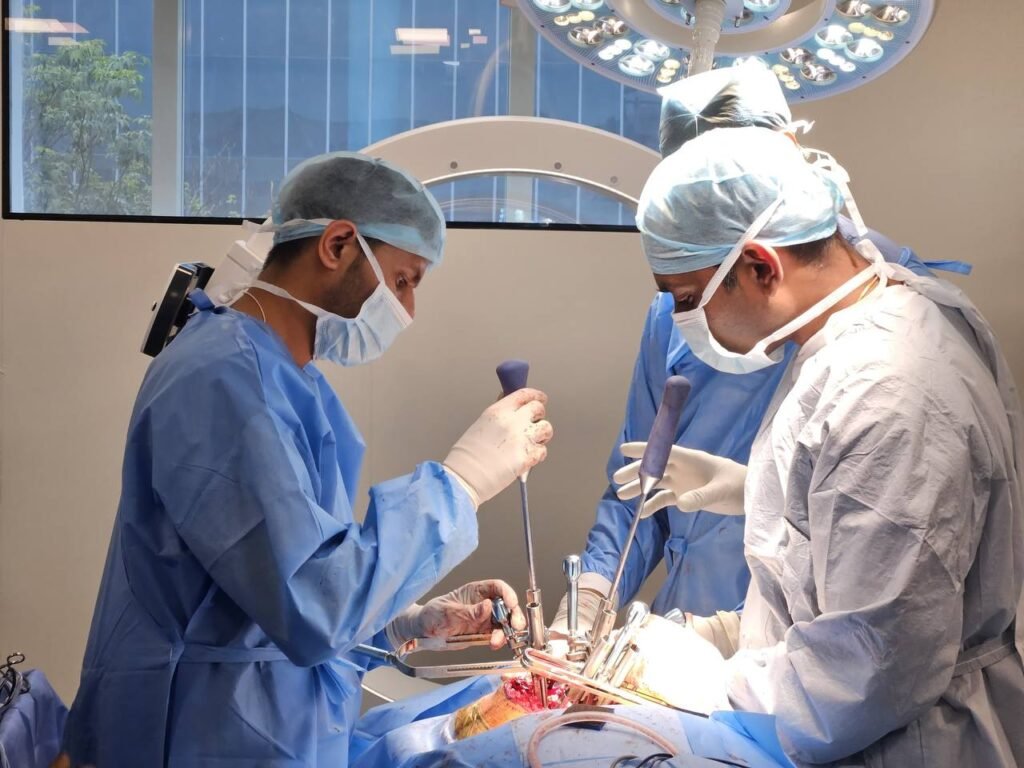
SpineDRX, under the leadership of Dr. Ramachandran, successfully performed a complex robotic-assisted scoliosis surgery at Aster Whitefield Hospital, Bangalore, using the ExcelsiusGPS® robotic navigation and guidance system.
The procedure represents an important advancement in the surgical management of complex spinal deformities, combining robotic guidance with real-time intraoperative imaging to support accurate screw placement and surgical planning.
Patient Presentation
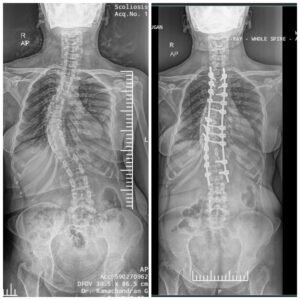
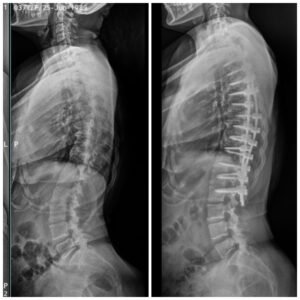
The patient was a middle-aged individual who presented with severe back pain and a marked, rigid kyphoscoliotic deformity, including a prominent kyphotic rib hump.
Given the complexity and rigidity of the spinal deformity, detailed preoperative assessment and careful surgical planning were essential to determine the appropriate approach for correction and stabilisation.
Surgical Challenge
Complex scoliosis and kyphoscoliosis can present significant challenges during spinal surgery. Abnormal spinal anatomy, rotational deformity and altered vertebral alignment can make accurate instrumentation particularly demanding.
In this case, the surgical objective was to achieve appropriate correction and stabilisation of the deformity while maintaining accurate placement of the spinal instrumentation.
Robotic-Assisted Surgical Approach
The procedure involved extensive T3 to L2 instrumentation and fusion for spinal deformity correction.
The surgical team utilised the ExcelsiusGPS® system, combined with real-time intraoperative CT imaging, to assist with the planning and placement of spinal screws.
Key Surgical Highlights
• Procedure: T3 to L2 instrumentation and fusion
• Condition: Complex rigid kyphoscoliotic spinal deformity
• Technology: ExcelsiusGPS® robotic guidance system
• Imaging: Real-time intraoperative CT imaging
• Objective: Deformity correction and spinal stabilisation
• Approach: Robotic-assisted and image-guided spinal instrumentation
Role of Robotic Navigation
Robotic-assisted spinal surgery can provide the surgical team with detailed guidance during instrumentation. When combined with intraoperative imaging, the technology can assist surgeons in accurately planning and executing screw trajectories according to the patient's individual spinal anatomy.
For complex deformity surgery, this technology can serve as an important aid alongside the surgeon's experience, clinical judgment and conventional surgical techniques.
Surgical Outcome
The procedure was completed with the planned spinal instrumentation and fusion. The use of robotic guidance and intraoperative imaging supported precise instrumentation during this complex deformity correction procedure.
The patient was subsequently managed through the postoperative recovery process under the care of the treating surgical team.
Why Complex Scoliosis Requires Specialist Evaluation
Scoliosis, kyphosis and kyphoscoliosis can vary considerably from one patient to another. Factors such as the degree and rigidity of the deformity, spinal balance, neurological status, age, symptoms and overall health need to be considered before determining an appropriate treatment strategy.
Treatment may range from observation and physiotherapy to specialised surgical intervention, depending on the individual patient's condition.
For patients with severe or progressive spinal deformities, consultation with an experienced spine specialist can help establish an accurate diagnosis and determine suitable treatment options.
Advanced Spine Care at SpineDRX
At SpineDRX, Dr. Ramachandran provides specialist evaluation and treatment planning for complex spinal conditions, including scoliosis, kyphosis, spinal deformities and chronic back pain.
The focus is on understanding each patient's individual condition and developing a treatment plan based on their symptoms, imaging findings, spinal alignment and overall health.
Conclusion
This complex kyphoscoliotic deformity correction demonstrates the role that robotic navigation and intraoperative imaging can play in modern spinal deformity surgery.
The successful procedure at Aster Whitefield Hospital combined advanced surgical technology with detailed planning and specialist spinal expertise to address a challenging spinal deformity.
If you are experiencing persistent back pain, scoliosis, kyphosis or another spinal deformity, consult a qualified spine specialist for a comprehensive evaluation and personalised treatment plan.