Advanced Slip Disc Treatment in Bangalore
A slipped disc can turn everyday life upside down. The pain that shoots down your leg when you bend over. The numbness in your fingers when you reach for something. The weakness that makes climbing stairs feel impossible. These are not just inconveniences — they are signs your spine needs expert attention.
Spine DRx, led by Dr. Ramachandran Govindasamy — one of Bangalore's most experienced spine surgeons — offers comprehensive, evidence-based slip disc treatment in Bangalore. From precise diagnosis and personalised conservative care to advanced minimally invasive surgery when needed, Dr. Ram helps patients across Bangalore reclaim their lives from disc-related pain.
With clinics in Whitefield and Kasavanahalli, and surgical care at Aster Whitefield Hospital, expert slip disc treatment in Bangalore has never been more accessible.
What Is a Slipped Disc?
Understanding the intervertebral disc
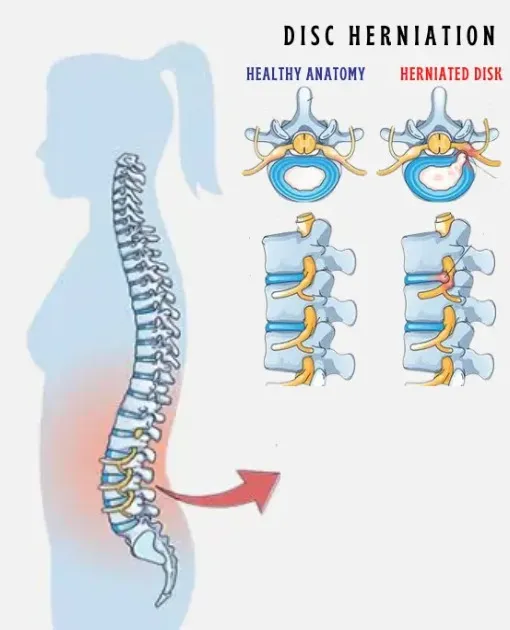
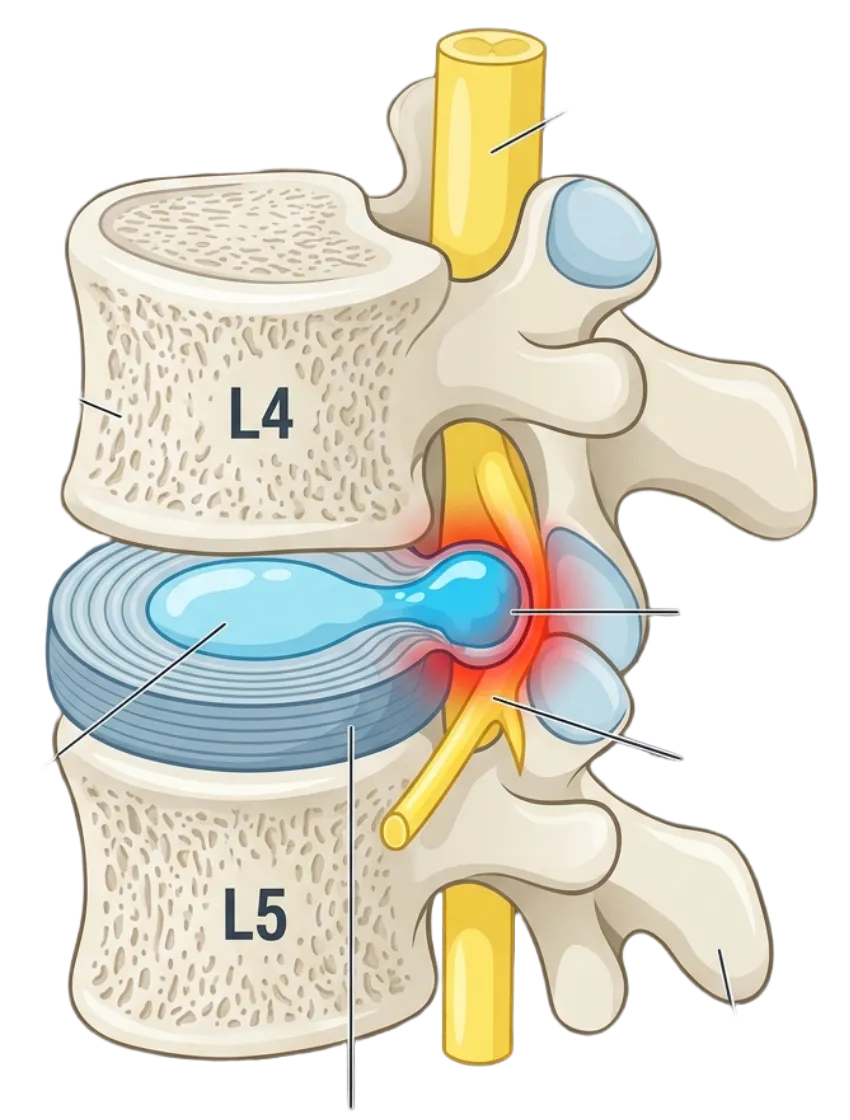
The spine is made up of 33 vertebral bones stacked on top of one another. Between each pair of vertebrae sits an intervertebral disc — a remarkable shock-absorbing structure with a tough outer ring (the annulus fibrosus) and a soft, gel-like inner core (the nucleus pulposus). These discs allow the spine to flex, bend, and twist while cushioning the bones from impact.
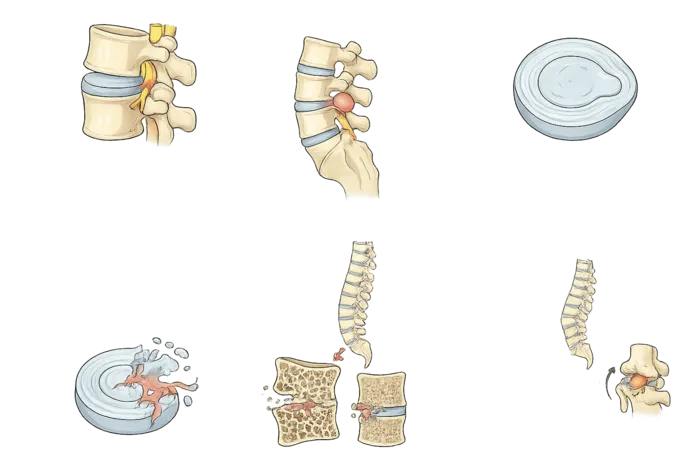
A slipped disc — also known medically as a herniated disc, prolapsed intervertebral disc (PIVD), or bulging disc — occurs when the soft inner core pushes through a crack or tear in the outer ring and presses against nearby spinal nerves. This nerve compression is what causes the characteristic pain, numbness, tingling, and weakness associated with the condition.
Other names for a slipped disc
You may have heard slipped disc referred to by several different names. All of these describe the same or closely related conditions:
- Herniated disc
- Prolapsed intervertebral disc (PIVD)
- Bulging disc
- Ruptured disc
- Disc prolapse
- Slipped vertebral disc
Where Do Slipped Discs Occur?
Slipped discs most commonly occur in two regions of the spine, each producing a distinct pattern of symptoms:
| Lumbar (Lower Back) Slipped Disc | Cervical (Neck) Slipped Disc |
|---|---|
| Most common location — L4-L5 and L5-S1 levels most frequently affected | Second most common — C5-C6 and C6-C7 levels most frequently affected |
| Causes lower back pain, sciatica (leg pain), foot weakness, numbness in legs | Causes neck pain, arm pain, hand weakness, balance issues, difficulty with fine motor tasks |
| Thoracic (mid-back) slipped discs are rare but do occur | Cervical disc prolapse can also cause myelopathy — spinal cord compression requiring urgent care |
Who Gets a Slipped Disc?
Slipped discs most commonly affect people in their 30s to 50s, though the condition can occur at any age — from teenagers to the elderly. In Bangalore's context:
- IT professionals and software engineers spending prolonged hours seated at desks
- Middle-aged males — historically the most affected demographic, though the condition is increasingly seen in women due to lifestyle changes
- Daily commuters — particularly those riding bikes or driving on Bangalore's rough, pothole-ridden roads
- Manual workers who regularly lift heavy loads with incorrect technique
- Athletes and physically active individuals following sports injuries
- Overweight individuals with weak core muscles placing excess load on the spine
Causes and Risk Factors for Slipped Disc
Natural disc degeneration
Every intervertebral disc undergoes gradual wear and tear as we age. The outer ring loses some of its elasticity and water content, making it more vulnerable to tears. This is a normal part of ageing — but certain factors can significantly accelerate the process.
Factors that speed up disc degeneration
- Obesity — excess body weight increases spinal load and disc pressure significantly
- Poor posture — sustained forward head posture, slouching, and rounded lower back posture during desk work
- Prolonged sitting — particularly relevant for Bangalore's large IT and office-working population
- Smoking — impairs blood supply to discs, accelerating degeneration
- Genetic predisposition — disc herniation can run in families
- Occupational hazards — heavy lifting, repetitive bending or twisting, driving for long hours
- Sudden trauma or injury — road accidents, falls, sports injuries
- Low physical activity and poor core muscle strength
- Advancing age — disc dehydration and loss of elasticity accelerates after age 35
Symptoms of a Slipped Disc — What to Look For
Lumbar (lower back) slipped disc symptoms
- Localised lower back pain — often described as a deep, aching pain
- Sciatica — sharp, burning, or shooting pain that travels from the lower back down through the buttock, thigh, calf, and into the foot
- Leg pain that worsens with sitting, coughing, or sneezing
- Numbness or tingling in the leg, foot, or toes
- Foot drop — weakness of the foot making it difficult to lift the front part
- Difficulty walking or standing for extended periods
- In severe cases: loss of bladder or bowel control (cauda equina syndrome — a medical emergency)
Cervical (neck) slipped disc symptoms
- Neck pain, stiffness, and difficulty looking up or turning the head
- Pain radiating from the neck down the shoulder, arm, and into the hand
- Numbness, tingling, or "pins and needles" in the fingers
- Weakness in the hands — difficulty gripping, writing, or buttoning clothes
- Balance problems and difficulty with coordinated movements
- In severe cases: cervical myelopathy — spinal cord compression causing walking difficulty, hand clumsiness, and bladder issues
Microscopic Lumbar Discectomy — SpineDRX's Gold Standard for Lumbar Slip Disc
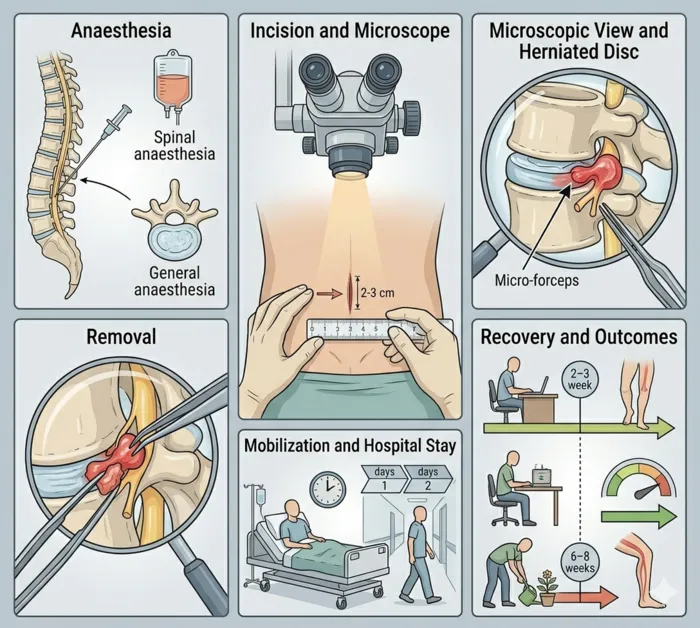
For lumbar slipped disc requiring surgery, Dr. Ram's procedure of choice is Microscopic Lumbar Discectomy — a minimally invasive operation performed under a surgical microscope through a small incision of just 2–3 cm.
- Performed under general or spinal anaesthesia
- Small incision — minimal tissue and muscle disruption
- Surgical microscope provides magnified, illuminated view of the nerve and disc
- The herniated disc fragment pressing on the nerve is precisely removed
- Most patients are mobilised on the same day as surgery
- Typical hospital stay: 1–2 days
- Return to desk work: 2–3 weeks in most cases
- Return to physical work: 6–8 weeks
- Success rate for sciatica relief: exceeds 90%
Why Choose SpineDRX for Slip Disc Treatment in Bangalore?
- Expert spine surgeon with extensive experience in lumbar and cervical disc disease
- Precise root-cause diagnosis — clinical examination correlated with MRI before any treatment decision
- Conservative-first philosophy — surgery only when truly necessary and clearly indicated
- Advanced minimally invasive surgical techniques — smaller incisions, less pain, faster recovery
- Safe Spine Surgery protocol — rigorous safety standards at every stage
- Same-day mobilisation after Microscopic Discectomy in most cases
- Transparent, patient-centred communication — Dr. Ram explains your diagnosis and all options clearly
- Two accessible clinic locations in Bangalore — Kasavanahalli and Whitefield
- Surgical care at Aster Whitefield Hospital — a leading multi-specialty facility
- Holistic, long-term focus — treating today's disc problem and preventing future recurrence
FAQs
The best treatment depends on the severity of your symptoms and which disc is affected. At SpineDRX, Dr. Ramachandran begins with conservative management — physiotherapy (ultrasound therapy and IFT), pain medications, posture correction, and activity modification. Around 90–95% of patients recover without surgery. If conservative treatment fails after 6 weeks, or if progressive weakness or loss of bladder/bowel control develops, minimally invasive surgery such as Microscopic Lumbar Discectomy is recommended. Yes — in approximately 90–95% of cases, a slipped disc heals on its own through the body's natural healing process, provided appropriate conservative treatment is followed. The herniated disc material gradually shrinks as the body reabsorbs it. This process typically takes 6–12 weeks. Conservative treatment during this time — physiotherapy, medications, and lifestyle modification — helps manage pain and protect the nerve while healing occurs. Most patients with a slipped disc improve within 6–12 weeks of starting conservative treatment. If surgery is required, Microscopic Lumbar Discectomy typically allows same-day mobilisation, with a hospital stay of 1–2 days. Return to desk work is usually possible within 2–3 weeks after surgery, and return to physical work within 6–8 weeks. Symptoms depend on which disc is affected. A lumbar (lower back) slipped disc typically causes lower back pain, sciatica (shooting pain down the leg), numbness or tingling in the leg or foot, and sometimes foot weakness. A cervical (neck) slipped disc causes neck pain, arm pain, hand weakness, and numbness in the fingers. Severe cases can cause loss of bladder or bowel control — a medical emergency requiring immediate surgical treatment. Dr. Ramachandran recommends surgery for a slipped disc when: (1) leg pain or arm pain persists beyond 6 weeks despite adequate conservative treatment, (2) progressive neurological weakness develops — such as foot drop or hand weakness, (3) pain is severe enough to significantly impair quality of life, or (4) cauda equina syndrome occurs — loss of bladder or bowel control — which is a surgical emergency. Microscopic Lumbar Discectomy is a minimally invasive surgical procedure used to treat lumbar slipped disc. It involves a small 2–3 cm incision and use of a surgical microscope to precisely remove the herniated disc fragment pressing on the nerve. It is a well-established, very safe procedure with over 90% success rate for relieving sciatica. Most patients are up and walking on the same day as surgery. Sciatica is not a diagnosis — it is a symptom. It refers to pain that travels along the sciatic nerve — from the lower back, through the buttock, and down the leg — and is most commonly caused by a lumbar slipped disc compressing a nerve root. So sciatica is often the result of a slipped disc, not a separate condition. Treating the underlying disc herniation at SpineDRX addresses the root cause of sciatica. Physiotherapy is a cornerstone of slip disc treatment and can be highly effective, particularly when combined with activity modification and pain management. It does not physically put the disc back in place, but it helps manage pain, strengthen the muscles that support the spine, reduce nerve irritation, and — critically — give the disc time and conditions to heal naturally. At SpineDRX, physiotherapy includes Ultrasound (US) therapy and Interferential Therapy (IFT) alongside structured exercise. Normal mechanical back pain typically stays localised in the neck or back without radiating to the arms or legs. A slipped disc is suggested when pain radiates — for example, shooting pain down the leg (sciatica) from a lumbar disc prolapse, or arm pain and hand tingling from a cervical disc prolapse. Numbness, weakness, or reflex changes also suggest nerve involvement from disc herniation. An MRI scan confirms the diagnosis. If in doubt, consult Dr. Ramachandran at SpineDRX for a clinical evaluation. You can book an appointment online at spinedrx.com/contact-us, or call 7996997989 for Spine DRx Clinic - Kasavanahalli or 7996992919 for Spine DRx Clinic - Whitefield or 9902290933 for Aster Whitefield. Dr. Ramachandran consults on Tuesday, Thursday, and Saturday evenings at Kasavanahalli, and Monday, Wednesday, and Friday evenings at Whitefield. Hospital consultations at Aster Whitefield are available all days except Sunday, 9 am to 5 pm.What is the best treatment for a slipped disc in Bangalore?
Can a slipped disc heal on its own without surgery?
How long does slip disc treatment take in Bangalore?
What are the symptoms of a slipped disc?
When is surgery needed for a slipped disc?
What is Microscopic Lumbar Discectomy and is it safe?
What is the difference between a slipped disc and sciatica?
Can physiotherapy cure a slipped disc?
How do I know if I have a slipped disc or just normal back pain?
How do I book an appointment for slip disc treatment at SpineDRX Bangalore?
Book Your Slip Disc Consultation in Bangalore — SpineDRX
A slipped disc is painful and disruptive — but with the right specialist and the right treatment plan, most patients make a full recovery without surgery. Do not let disc pain hold you back from the life you want to live. Consult Dr. Ramachandran at SpineDRX — Bangalore's trusted destination for slip disc treatment. Accurate diagnosis. Personalised treatment. Lasting relief.