
Lumbar Spondylolisthesis Treatment in Bangalore – Expert Spine Care
If you have lower back pain that worsens with standing or walking, along with leg pain, tingling, or a feeling of instability in your spine, you may have spondylolisthesis — a condition where one vertebra slips forward over the one below it, most often at L4-L5. Dr. Ramachandran Govindasamy, a leading spine surgeon in Bangalore, provides comprehensive Lumbar Spondylolisthesis treatment in Bangalore.
Spondylolisthesis is treated based on severity — mild instability pain responds to a lumbo-sacral corset and physiotherapy, sciatica pain can be managed with injections and medication, and cases that don't improve with conservative care may need spinal fusion surgery (TLIF, OLIF, ALIF, or PLIF) to stabilize the slipped vertebra and relieve nerve pressure.
At SpineDrx, our highly experienced spine specialists and surgeons in Bangalore provide personalized treatment for Lumbar Spondylolisthesis, helping patients achieve lasting pain relief, improved mobility, and a better quality of life.
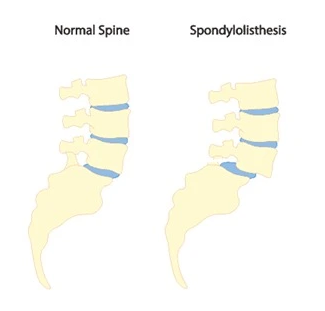
What Is Spondylolisthesis?
The spine is a stack of vertebrae held together by discs and ligaments in the front and facet joints — small hook-like connections — at the back. Spondylolisthesis occurs when one vertebra slips forward over the one beneath it, most commonly at the L4-L5 level of the lower back. This slippage can destabilize the spine and put pressure on nearby nerves.
Common Causes of Lumbar Spondylolisthesis
| Type | What Happens |
|---|---|
| Lytic (Isthmic) Spondylolisthesis | A stress fracture (pars lysis) breaks the bony "hook" (pars interarticularis) connecting adjacent vertebrae — most common in middle-aged individuals |
| Degenerative Spondylolisthesis | The facet joints wear out with age and lose their ability to hold vertebrae in place — most common in the elderly, especially at L4-L5 |
| Disc Prolapse-Related | The intervertebral disc fails to keep adjoining bones aligned, allowing slippage |
| Dysplastic Spondylolisthesis | The facet joints, bone, or ligaments don't develop normally from birth — most common in adolescents, can lead to scoliosis |
Who Is Most at Risk of Developing Spondylolisthesis?
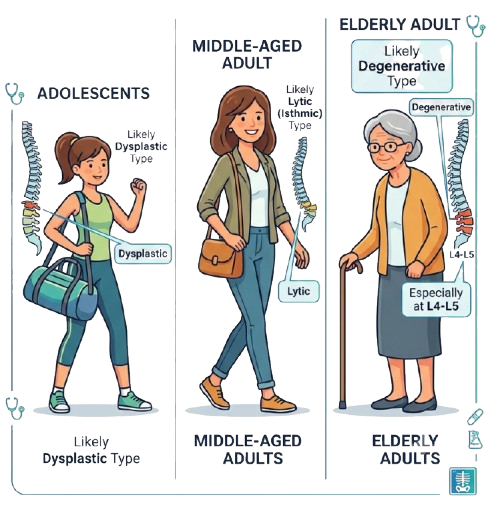
Spondylolisthesis can affect people of all ages, but the risk varies depending on age, gender, lifestyle, and the underlying cause. While the condition is generally more common in women, certain types are more likely to occur during specific stages of life.
- Adolescents & Young Athletes – More likely to develop dysplastic or isthmic (lytic) spondylolisthesis, often due to congenital spinal abnormalities or repetitive stress.
- Middle-Aged Adults – Commonly affected by isthmic (lytic) spondylolisthesis, which develops from stress fractures in the vertebra over time, leading to spinal instability.
- Older Adults (50+ Years) – Most frequently develop degenerative spondylolisthesis, particularly at the L4-L5 level, as age-related wear and tear weakens the spinal joints, discs, and supporting ligaments.
Common Symptoms of Lumbar Spondylolisthesis
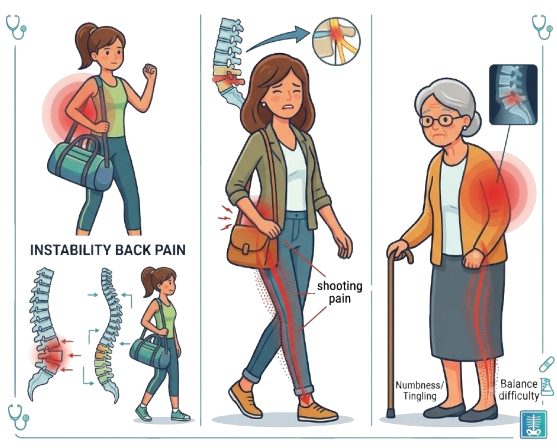
As one vertebra slips forward over the one below it, it can place stress on the spine, compress nearby nerves, and reduce spinal stability. This may lead to persistent lower back pain, difficulty with everyday activities, and reduced mobility. Symptoms vary depending on the severity of the slippage and the extent of nerve involvement.
- Lower Back Pain & Instability – Persistent pain that worsens with standing, walking, bending, or spinal movement due to instability in the affected vertebra.
- Sciatica & Nerve Compression – Shooting pain that radiates down the leg, along with numbness, tingling, or weakness caused by pressure on the spinal nerves.
- Postural Changes – Changes in posture, difficulty maintaining balance, and an altered walking pattern may develop as the spine compensates for the slipped vertebra.
Treatment Options for Spondylolisthesis in Bangalore
1. Non-Surgical Management
- Lumbo-sacral corset/brace to reduce instability pain
- Targeted physiotherapy and core-strengthening exercises
- Epidural or nerve-root injections and oral medication for sciatica pain
2. Surgical Treatment
If conservative treatment doesn't relieve symptoms, spinal fusion stabilizes the slipped segment and decompresses the affected nerve. Dr. Ramachandran offers a full range of fusion techniques, chosen based on each patient's spinal balance and anatomy:
- TLIF — Transforaminal Lumbar Interbody Fusion
- OLIF — Oblique Lumbar Interbody Fusion (minimally invasive)
- ALIF — Anterior Lumbar Interbody Fusion
- PLIF — Posterior Lumbar Interbody Fusion
Dr. Ramachandran's Approach: Balancing the Whole Spine
Dr. Ramachandran treats spondylolisthesis with a focus on restoring balance to the entire spine, not just the slipped level. His surgical planning is guided by:
- Whole-spine X-rays to assess overall spinal alignment and balance parameters
- Careful, individualized planning of surgical levels rather than a one-size-fits-all fusion
- A choice between traditional and minimally invasive techniques (including MIS TLIF and OLIF) based on what best suits each patient
This comprehensive, balance-focused approach helps avoid adjacent-segment problems later and gives patients a more durable long-term result.
- 14+ years of dedicated spine surgery experience
- Whole-spine balance assessment before surgical planning
- Range of Lumbar Fusion techniques — traditional and minimally invasive (MIS TLIF, OLIF)
- Available across multiple Bangalore locations: Whitefield, Kasavanahalli
FAQs
Lumbar spondylolisthesis is a condition where one vertebra in the lower spine slips forward over the vertebra below it, most commonly at the L4-L5 level. It can cause instability back pain and, if a nerve is affected, sciatica. Common symptoms include lower back pain that worsens with standing, walking, or spinal movement (instability pain), and sciatica — leg pain, numbness, or tingling — if the slippage stretches or compresses a nerve. Causes include a stress fracture in the bony connection between vertebrae (lytic/isthmic type), age-related wear of the facet joints (degenerative type), disc failure, or abnormal development of the spine's supporting structures from birth (dysplastic type). Yes, many cases improve with a lumbo-sacral corset, physiotherapy, and — for sciatica — injections or oral medication. Surgery is considered only if these conservative measures fail to relieve symptoms. Spinal fusion is the standard surgical treatment, performed using techniques such as TLIF, OLIF, ALIF, or PLIF. The specific technique is chosen based on the patient's anatomy and overall spinal balance. Yes. Degenerative spondylolisthesis, caused by age-related wear of the facet joints, is the most common type in elderly patients and frequently occurs at the L4-L5 level. No. Many patients respond well to non-surgical management. Fusion surgery is reserved for cases with persistent instability pain, significant nerve compression, or when conservative treatment fails. Whole-spine X-rays allow assessment of overall spinal balance, not just the slipped level, helping plan the correct surgical levels and reducing the risk of problems developing at adjacent spinal segments later. Dr. Ramachandran Govindasamy provides comprehensive, balance-focused lumbar spondylolisthesis treatment at Spine DRx Clinics in Whitefield and Kasavanahalli, Bangalore.What is lumbar spondylolisthesis?
What are the symptoms of spondylolisthesis?
What causes a vertebra to slip?
Can spondylolisthesis be treated without surgery?
What surgery is used for spondylolisthesis?
Is degenerative spondylolisthesis common in older adults?
Does spondylolisthesis always need fusion surgery?
Why does Dr. Ramachandran use whole-spine X-rays for planning?
Where can I get expert spondylolisthesis treatment in Bangalore?
Book a Consultation for Lumbar Spondylolisthesis Treatment
Don't ignore persistent back pain with leg symptoms. Early evaluation of spondylolisthesis can prevent progression and often avoids the need for surgery altogether.