
Lumbar Spine Decompression Surgery Bangalore
Expert MIS tubular internal decompression by Dr. Ramachandran Govindasamy — relieving lumbar canal stenosis, nerve compression and neurogenic claudication through a single keyhole incision.
24 hrs
Mobilisation
Keyhole
Single incision
1 - 2
Days hospital stay
What Is Lumbar Spine Decompression Surgery?
Lumbar spine decompression surgery in Bangalore is a procedure designed to relieve pressure on the nerves of the lower back — most commonly caused by lumbar canal stenosis, herniated discs, or thickened ligaments. At SpineDRX, Dr. Ramachandran Govindasamy performs this using the MIS tubular internal decompression technique — a keyhole, minimally invasive approach that avoids the large incisions and extended recovery of traditional open surgery.
Lumbar canal stenosis causes the spinal canal to narrow, compressing the nerve roots as they travel down into the legs. This produces a characteristic pattern of pain — neurogenic claudication — where patients develop worsening leg pain, heaviness, tingling or weakness with walking, often relieved only by sitting or bending forward. Untreated, the condition progressively limits mobility and quality of life.
- Lumbar Canal Stenosis
- Herniated Disc
- Neurogenic Claudication
- Nerve Root Compression
- Ligamentum Flavum Hypertrophy
- Facet Joint Hypertrophy
How MIS Tubular Internal Decompression Works
MIS tubular internal decompression is performed under general or spinal anaesthesia and typically takes 60–90 minutes. Here is a step-by-step overview of what happens during lumbar spine decompression surgery in Bangalore at SpineDRX:
Small keyhole incision
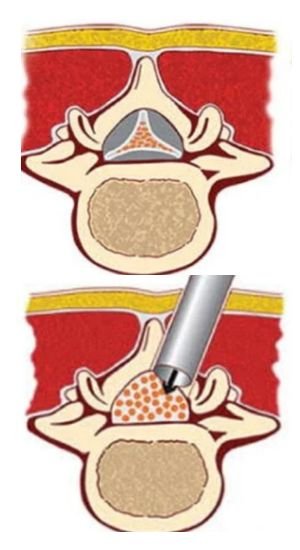
A single small incision (approximately 1.5–2 cm) is made in the lower back, guided by intraoperative X-ray imaging to precisely target the affected spinal level.
Tubular retractor placement
A series of progressively larger dilators are passed through the incision, gently spreading — rather than cutting — the back muscles. A working tube is then positioned over the affected vertebral level.
Microscopic decompression
Under high-powered microscopic vision, Dr. Ramachandran removes the hypertrophied facet joints, thickened ligamentum flavum, and any prolapsed disc material that are compressing the spinal nerves.
Bilateral decompression from one side
A key advantage of Dr. Ramachandran's technique is the ability to decompress nerve roots on both sides of the spinal canal through the single-side keyhole approach — eliminating the need for a second incision on the opposite side.
Closure and recovery
The tube is removed and the small incision is closed with absorbable sutures. Most patients are walked within 24 hours and discharged within 1–2 days.
Lumbar Decompression Surgery at a Glance
MIS tubular internal decompression is performed under general or spinal anaesthesia and typically takes 60–90 minutes. Here is a step-by-step overview of what happens during lumbar spine decompression surgery in Bangalore at SpineDRX:

Duration
60 – 90 minutes

Hospital Stay
1 – 2 days

Anaesthesia
General or spinal

Walking
Within 24 hours

Full Recovery
4 – 6 weeks

Incision
Single keyhole (~1.5 cm)
Indications
Who Needs Lumbar Spine Decompression Surgery?
Dr. Ramachandran recommends lumbar spine decompression surgery in Bangalore for patients who meet the following criteria:
The Journey
Benefits of Minimally Invasive Lumbar Decompression
Compared to traditional open spinal decompression surgery, the MIS tubular technique at SpineDRX Bangalore offers significant advantages:
Smaller incision
A single ~1.5 cm keyhole incision versus a 5–10 cm open cut, resulting in far less scarring.
Minimal muscle damage
uscles are gently dilated rather than cut, preserving spinal stability and reducing post-operative pain.
Faster recovery
Most patients are discharged within 1–2 days and return to normal activities within 4–6 weeks.
Less blood loss
The precise tubular approach significantly reduces intraoperative blood loss compared to open surgery.
Lower infection risk
The smaller wound footprint translates to a measurably lower risk of surgical site infection.
Bilateral relief, single incision
Dr. Ramachandran's technique decompresses both sides of the canal through one approach — no second cut needed.
Recovery After Lumbar Decompression Surgery in Bangalore
Recovery after MIS lumbar spine decompression surgery is considerably faster than traditional open surgery. Here is what patients can typically expect:
| Timeframe | What to Expect |
|---|---|
| Day 1 (post-op) | Mobilised with physiotherapist support; pain well-controlled with oral medication |
| Day 1–2 | Discharged home; walking independently with minor assistance if needed |
| Week 1–2 | Light activities at home; dressing removed; incision check at clinic |
| Week 2–4 | Return to sedentary work; short walks increased progressively; avoid heavy lifting |
| Week 4–6 | Return to most daily activities and desk work; physiotherapy commences |
| 3 months | Full return to work including moderate physical activity; follow-up MRI if needed |
FAQs
Lumbar spine decompression surgery in Bangalore is a procedure that relieves pressure on compressed spinal nerves in the lower back. At SpineDRX, Dr. Ramachandran uses the MIS tubular technique — a keyhole approach that removes excess bone, thickened ligaments and disc material through a tiny incision, freeing the trapped nerves without the trauma of open surgery. Patients with confirmed lumbar canal stenosis causing neurogenic claudication (leg pain and weakness on walking), those with herniated discs compressing nerve roots, and individuals who have not responded to conservative treatments such as physiotherapy, pain management or epidural injections over 6–12 weeks are typically candidates. MIS tubular internal decompression is a keyhole spine surgery in which a small tube is inserted through a tiny back incision. Under microscopic vision, the surgeon removes the hypertrophied facet joint bone, thickened ligamentum flavum and any prolapsed disc that is compressing the spinal nerves. Dr. Ramachandran's technique decompresses both sides of the spinal canal through a single-side approach. With the MIS technique, most patients are walking within 24 hours of surgery and are discharged within 1–2 days. Return to light daily activities typically occurs within 2–4 weeks. Full recovery, including return to more physical work, usually takes 4–6 weeks — significantly faster than the 6–12 weeks typical of open spinal surgery. MIS lumbar decompression involves a single small keyhole incision (versus a large open cut), significantly less muscle disruption, reduced blood loss, a shorter 1–2 day hospital stay (versus 4–7 days for open surgery), faster return to daily activities and a lower risk of wound infection and long-term back weakness. Dr. Ramachandran Govindasamy provides outpatient spine consultations at SpineDRX clinics in Whitefield and Kasavanahalli, with lumbar spine decompression surgery performed at Aster Whitefield Hospital, Bengaluru, when surgery is recommended. Yes — lumbar decompression surgery performed by an experienced spine surgeon is a well-established and safe procedure. The MIS tubular approach used by Dr. Ramachandran further reduces inherent surgical risks by minimising tissue damage, blood loss and operative time. As with all surgeries, risks such as infection, bleeding or dural tear exist but are uncommon in expert hands.What is lumbar spine decompression surgery in Bangalore?
Who is a candidate for lumbar decompression surgery?
What is MIS tubular internal decompression?
How long is recovery after lumbar decompression surgery?
What are the advantages of minimally invasive lumbar decompression over open surgery?
Where can I get lumbar spine decompression surgery in Bangalore?
Is lumbar decompression surgery safe?