
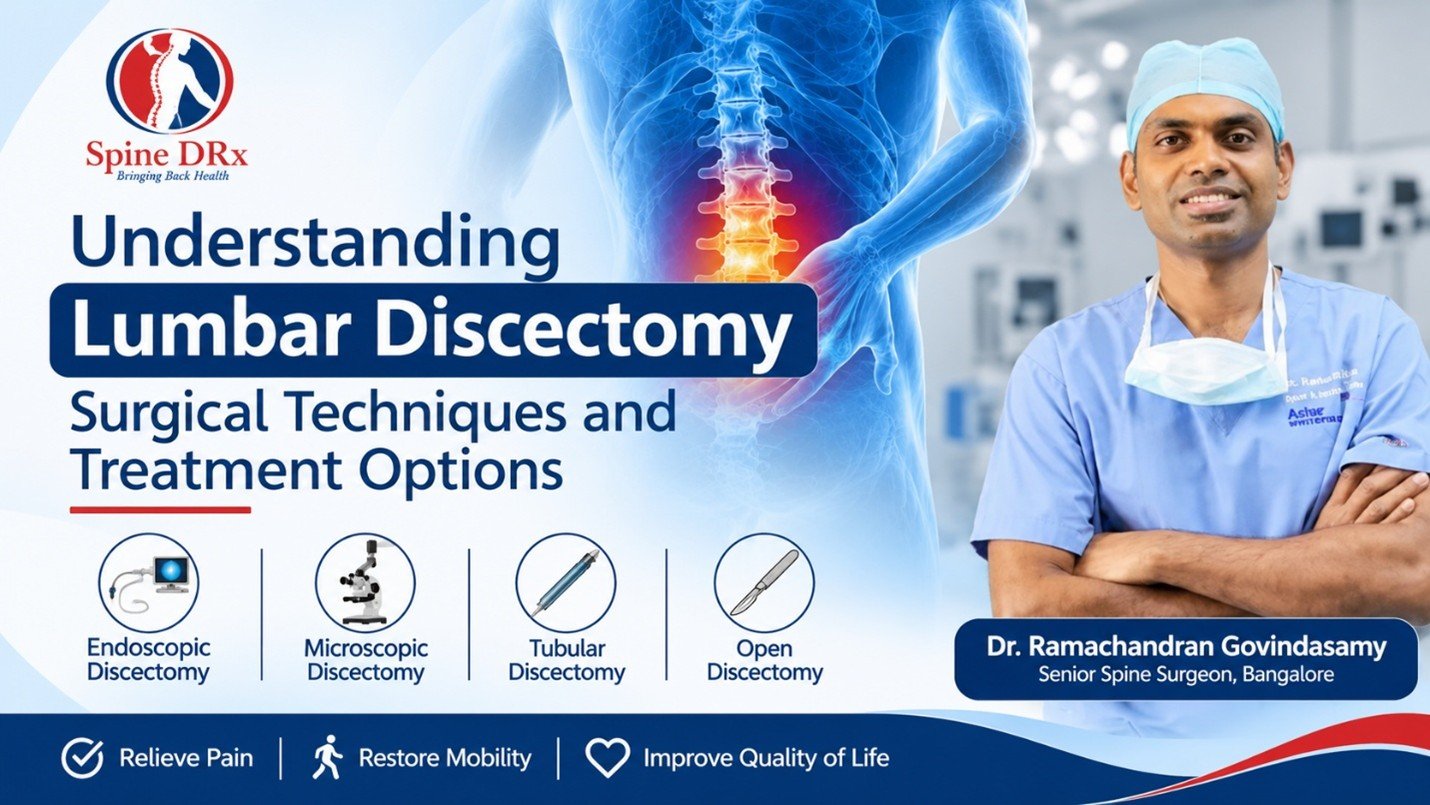
Persistent lower back pain shooting pain down the leg and numbness can sometimes point to an issue with the lumbar discs. When a disc in the spine bulges or moves, out of place it can squeeze nearby spinal nerves. This pressure often leads to pain and discomfort. If medicines, physiotherapy and other non-surgical treatments do not ease the symptoms a doctor might suggest lumbar discectomy surgery. At Spine DRx, patients can consult an experienced spine specialist for evaluation and treatment of various spinal conditions.
Lumbar discectomy is an option that removes the part of the damaged or herniated disc that is pressing on a spinal nerve. The type of surgery used depends on the patient’s condition. The surgeon may use a method, a microscopic technique, a tubular approach or an open surgery.
Knowing how these different techniques work can help patients better understand their treatment choices. This knowledge allows them to make decisions that fit their health needs and personal preferences.
Need expert advice for a herniated disc or persistent back pain? Consult Dr. Ramachandran Govindasamy at Spine DRx for an evaluation and suitable treatment options.
What Is Lumbar Discectomy Surgery?
Lumbar discectomy surgery is a procedure performed to remove the part of a herniated or damaged intervertebral disc that compresses a nerve in the lower back.
The lumbar spine consists of five vertebrae. Soft discs separate these vertebrae. These discs act as cushions. They allow the spine to move. When the outer layer of a disc weakens or tears the inner material of the disc may protrude. The protruding material can compress nerves. This problem is called a lumbar disc herniation or slipped disc. I have seen patients who feel the pain.
Compression of a nerve can cause back pain. The pain may spread to the legs. This spread is called sciatica. I have heard patients describe tingling, numbness or muscle weakness in the legs. The pain may also cause muscle weakness, in the legs.
During a lumbar discectomy the surgeon removes disc material that compresses the nerve. The surgeon removes this material carefully. Removing the material relieves pressure on the nerve. I have watched surgeons perform the procedure and see patients feel relief.
When Is Lumbar Discectomy Surgery Recommended?
Not everyone with a herniated disc requires surgery. Many patients improve with conservative treatments such as medication, activity modification and physiotherapy.
However, lumbar discectomy may be considered when:
- Persistent lower back pain or leg pain does not improve with non-surgical treatment.
- Sciatica interferes with daily activities, walking or sleep.
- A herniated disc causes ongoing nerve compression.
- Numbness or muscle weakness develops due to nerve involvement.
- Imaging findings match the patient's symptoms and clinical examination.
Severe or progressive leg weakness, or new loss of bladder or bowel control, requires urgent medical assessment. These symptoms can indicate serious nerve compression.
Types of Lumbar Discectomy Surgery
Lumbar discectomy can be carried out through surgical approaches. The decision about which surgical approach, to use depends on the location and size of the disc the amount of nerve compression the patient’s overall health and the surgeon’s evaluation.
1. Endoscopic Discectomy Surgery
Endoscopic discectomy is a minimally invasive treatment that uses a slender tool called an endoscope, which carries a camera and light.
The surgeon makes a cut and guides the endoscope, toward the problem disc.
With tools the surgeon removes the herniated disc material that presses on the spinal nerve completing the endoscopic discectomy.
Potential benefits include:
- Smaller surgical incision.
- Less disruption to surrounding muscles in suitable cases.
- Reduced blood loss in many cases.
- Potentially shorter hospital stays.
- Faster return to routine activities for appropriately selected patients.
Endoscopic discectomy may be suitable for certain types and locations of lumbar disc herniation.
2. Microscopic Lumbar Discectomy
As a patient you might wonder what microscopic lumbar discectomy, also known as microdiscectomy is. Microscopic lumbar discectomy uses a microscope to give a magnified view of the spinal area that is hurt.
The surgeon makes a cut and then moves carefully through the nearby tissues to reach the herniated disc. The surgical microscope provides a view of the spinal nerves and disc material while the surgery is happening.
The surgeon removes the part of the disc that is pressing on the nerve and tries to keep much healthy tissue as possible.
Potential benefits include:
- Magnified visualization of the surgical area.
- Precise identification of nerve structures.
- Smaller incision compared with many traditional open approaches.
- Reduced disruption to surrounding tissues in suitable cases.
Microdiscectomy is a commonly performed surgical option for patients with symptomatic lumbar disc herniation.
3. Tubular Discectomy Surgery
Tubular discectomy is an invasive approach used to treat selected cases of lumbar disc herniation.
I imagine the surgeon making an incision and inserting a specialized tubular retractor to create a narrow working passage, toward the affected disc.
Of widely exposing the surgical area the surgeon works through this tube using specialized instruments and magnification to remove the herniated disc material.
Potential benefits include:
- Limited muscle separation.
- Smaller surgical access.
- Reduced soft tissue disruption in suitable cases.
- Less blood loss in many patients.
- Potentially quicker postoperative recovery.
Tubular discectomy may be considered when the patient's condition is suitable for this surgical approach.
4. Open Lumbar Discectomy
Open lumbar discectomy is a surgical method that removes herniated disc material from the lower spine.
The surgeon makes an incision above the spinal level and carefully opens the surgical area so that the surgeon can reach the herniated disc.
If the disc is in a spot or the anatomy is particular the surgeon may need to remove a small piece of bone or ligament to safely reach the affected nerve.
After that the surgeon removes the disc material that is pressing on the nerve.
In some cases, the procedure may also involve a laminotomy or laminectomy so that the surgeon has access, to the affected area.
Potential benefits include:
- Direct access to the affected spinal structures.
- A well-established surgical approach.
- Flexibility in managing selected complex disc conditions.
- Ability to address additional anatomical issues when necessary.
The choice between an open and minimally invasive approach depends on the individual patient's spinal condition.
Comparison of Different Lumbar Discectomy Techniques
|
Surgical technique |
Approach |
Key feature |
|
Endoscopic discectomy |
Minimally invasive |
Uses an endoscope and camera |
|
Microscopic discectomy |
Microscope-assisted |
Provides magnified surgical visualization |
|
Tubular discectomy |
Minimally invasive |
Uses a tubular retractor |
|
Open discectomy |
Traditional approach |
Provides direct surgical access |
Each technique has its own indications and limitations. A spine surgeon evaluates the patient's condition before recommending the most appropriate approach.
Benefits of Lumbar Discectomy Surgery
When performed on appropriately selected patients, lumbar discectomy can help relieve symptoms caused by nerve compression.
Some potential benefits include:
- Relief from sciatica and radiating leg pain.
- Reduced pressure on compressed spinal nerves.
- Improvement in nerve-related symptoms.
- Better mobility and ability to perform daily activities.
- Improved quality of life.
The results vary depending on the extent of nerve compression, the patient's overall health and the duration of symptoms. Back pain may not improve to the same extent as leg pain in every patient.
Considering Spine Surgery?
Get expert guidance on surgical and non-surgical treatment options for lumbar disc problems at Spine DRx.
What Are the Risks and Possible Complications?
Like any surgical procedure, lumbar discectomy carries certain risks. Although many patients undergo the procedure without major complications, possible risks include:
- Infection at the surgical site.
- Bleeding.
- Nerve irritation or injury.
- Dural tear and cerebrospinal fluid leakage.
- Persistent pain or numbness.
- Recurrent disc herniation.
- Blood clots or an aesthesia-related complications.
A detailed evaluation before surgery helps the surgeon understand potential risks and discuss appropriate precautions.
Recovery After Lumbar Discectomy Surgery
Recovery after lumbar discectomy is different, for each person. It depends on the technique used the health of the patient and how much work was done during the procedure. Many patients are told to start walking with help after surgery. This is based on how they're feeling and what the surgeon says.
The recovery process generally involves:
After Surgery: Patients are watched for pain, movement and other symptoms that happen after surgery. Walking can start when the doctor says it is safe.
Few Weeks: Patients slowly start doing light everyday tasks. Patients avoid any movements or activities that the surgeon told them to stay from.
Following Weeks: Patients can slowly walk more. Do the rehab exercises that the doctor prescribed.
Long-Term Recovery: Patients can slowly get back to work exercise and other activities as their healing goes forward and as the doctor advises.
Following instructions attending follow-up appointments and staying away from activities that put too much strain on the spine are key, for recovery.
Who Is a Suitable Candidate for Lumbar Discectomy?
Lumbar discectomy may be recommended for patients who have:
- A confirmed lumbar disc herniation.
- Persistent sciatica or nerve-related leg pain.
- Symptoms that have not improved with appropriate conservative treatment.
- Imaging findings that correspond with their symptoms.
- Significant functional limitations due to nerve compression.
A clinical examination and MRI evaluation help determine whether surgery is appropriate.
Why Choose Spine DRx for Spine Care?
Choosing the right spine specialist is an important part of managing a herniated disc and other spinal conditions.
At Spine DRx, Dr. Ramachandran Govindasamy provides specialist evaluation and treatment for various spinal conditions. Treatment recommendations are based on the patient's symptoms, clinical findings and imaging results.
The treatment approach looks for the root cause of pain. Weighs both surgical and non-surgical options.
Patients receive guidance about their condition the treatment approach options and what to expect during recovery.
If you are dealing with lower back pain, sciatica or symptoms of a herniated disc you should consult a spine specialist, for an appropriate evaluation.
Looking for Lumbar Discectomy Treatment in Bangalore?
Consult Dr. Ramachandran Govindasamy at Spine DRx to understand your condition and explore appropriate treatment options.