Spinal Osteotomy Surgery in Bangalore — Expert Correction of Complex Spine Deformities at SpineDRX
A spine that cannot straighten. A posture so stooped that looking ahead requires enormous effort. A curvature so severe that it compresses the lungs and digestive organs. These are not merely cosmetic concerns — severe spinal deformities are debilitating conditions that affect every dimension of a patient's life, from breathing and digestion to walking, working, and sleeping.
For patients with severe, rigid, or fixed spinal deformities that cannot be corrected by non-surgical means, spinal osteotomy surgery offers the most powerful available intervention — surgically cutting, repositioning, and fusing the spinal bones to restore alignment, balance, and function.
Dr. Ramachandran Govindasamy at SpineDRX, Bangalore, is among the region's most experienced spine surgeons for complex deformity correction surgery. With deep expertise in the full spectrum of spinal osteotomy techniques — from Smith-Peterson and Ponte osteotomies through Pedicle Subtraction Osteotomy (PSO) to Vertebral Column Resection (VCR) — Dr. Ram offers patients in Bangalore access to internationally benchmarked spinal osteotomy surgery.
What Is Spinal Osteotomy Surgery?
The word “osteotomy” comes from the Greek words osteon (bone) and tome (cut). A spinal osteotomy is a surgical procedure in which one or more vertebral bones are precisely cut, removed, or repositioned to correct abnormal spinal curvature or alignment.
The spine is normally straight when viewed from the front and has natural curves when viewed from the side. However, in certain conditions, these alignments become abnormal, leading to spinal deformities such as kyphosis and scoliosis. These abnormal curvatures can become severe and extend beyond the normal range, requiring surgical correction.
When the deformity is rigid and cannot be corrected through non-surgical methods or flexible correction techniques, osteotomy surgery may be required. During these procedures, specific portions of the spinal bones are removed, and the spine is realigned to a more normal position using specialized instrumentation and fixation systems.
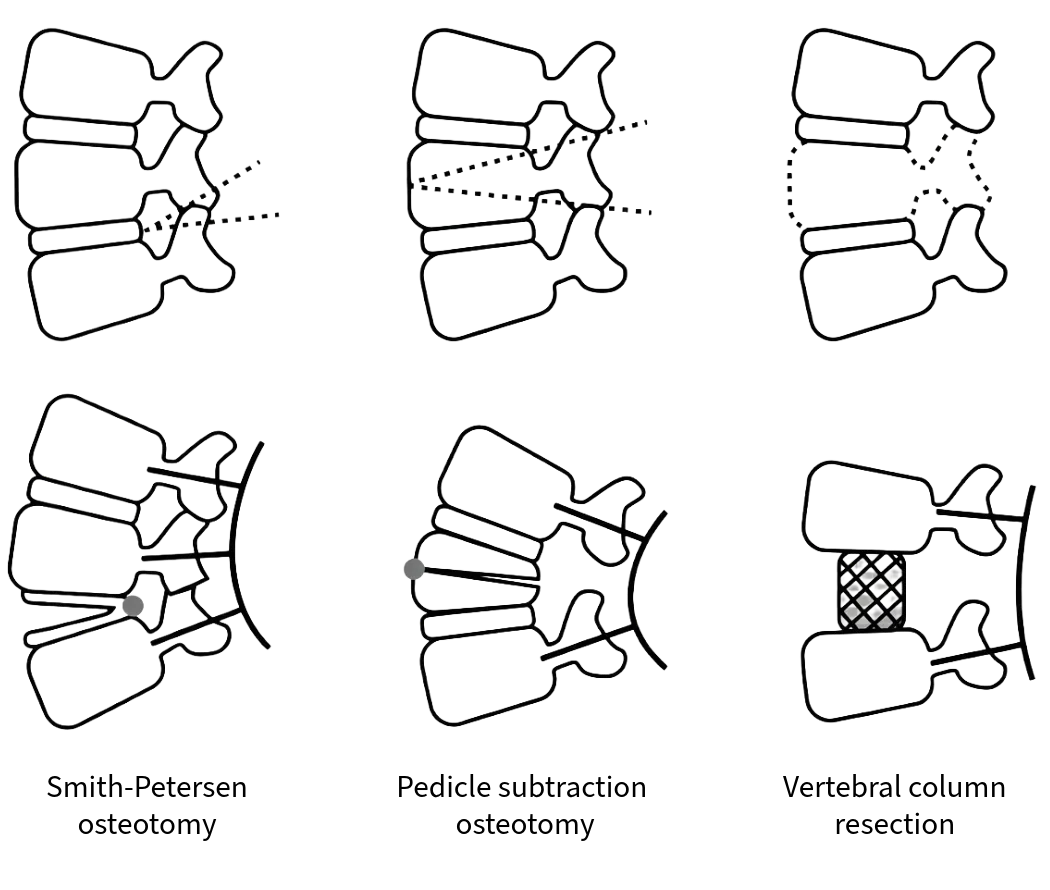
There are several types of spinal osteotomies, classified based on the amount and location of bone removed. Common types include Smith-Petersen Osteotomy (SPO), Pedicle Subtraction Osteotomy (PSO), and Vertebrectomy, among others.
Common Causes of Neck and Back Pain in Bangalore
Spinal osteotomy surgery is indicated for severe spinal deformities that cause significant functional impairment and cannot be managed with conservative treatment or less invasive surgery. The most common conditions treated include:
Kyphosis (abnormal forward curvature)
Kyphosis refers to an exaggerated forward rounding of the spine. While some forward curve in the thoracic spine is normal, pathological kyphosis — particularly when rigid or severe — causes a characteristic stooped posture, back pain, restricted breathing, difficulty swallowing, and inability to look ahead while standing.
- Scheuermann's kyphosis — rigid, structural kyphosis developing during adolescence due to vertebral wedging
- Post-traumatic kyphosis — kyphotic deformity following a vertebral fracture that healed in a collapsed, forward-angulated position
- Post-infectious kyphosis — deformity following spinal tuberculosis (Pott's disease) or other vertebral infections that destroyed vertebral bodies
- Degenerative kyphosis — age-related kyphotic collapse in adults and the elderly
- Iatrogenic kyphosis — deformity following previous spinal surgery (laminectomy-related kyphosis)
- Congenital kyphosis — present from birth due to abnormal vertebral development
Scoliosis (lateral spinal curvature)
Scoliosis is an abnormal lateral (sideways) curvature of the spine, often combined with rotation. When a scoliotic curve exceeds 40–50 degrees, or when it is rigid and associated with pain, neurological compromise, or cardiopulmonary dysfunction, surgical correction may be required.
- Adolescent idiopathic scoliosis (AIS) — the most common form; curves exceeding 45–50 degrees in skeletally immature patients requiring correction
- Adult degenerative scoliosis — de novo scoliosis in adults due to asymmetric disc degeneration
- Neuromuscular scoliosis — associated with cerebral palsy, muscular dystrophy, spinal muscular atrophy
- Congenital scoliosis — structural abnormalities present from birth
Flat-back syndrome
Flat-back syndrome occurs when the normal lordotic (inward) curve of the lumbar spine is lost — resulting in a rigid, upright posture that forces the patient to lean forward when attempting to stand straight. It is a common long-term complication of certain spinal fusion surgeries using older instrumentation techniques, and requires osteotomy to restore lumbar lordosis.
Ankylosing spondylitis
Ankylosing spondylitis is an inflammatory arthritis that progressively fuses the spinal joints, resulting in a rigid, bamboo-like spine fixed in a severely stooped, chin-on-chest posture. When the deformity is severe and functionally disabling, a spinal osteotomy — typically a PSO at the lumbar spine — can dramatically restore the patient's ability to stand upright and look ahead.
Fixed sagittal imbalance
Sagittal imbalance refers to a situation where the centre of gravity has shifted so far forward that the patient cannot stand upright without expending enormous muscular effort, causing severe fatigue, pain, and functional limitation. Osteotomy corrects the sagittal alignment and restores the patient's natural centre of gravity.
Types of Spinal Osteotomy Surgery — The SpineDRX Approach
Dr. Ramachandran selects the type of osteotomy based on the nature and rigidity of the deformity, the amount of correction required, the location of the apex of the curve, and the patient's overall health. The three principal osteotomy techniques — each offering progressively greater correction at progressively greater complexity — are:
1. Smith-Peterson Osteotomy (SPO) / Ponte Osteotomy
| Also known as | Ponte osteotomy (when performed at multiple levels without anterior column disruption) |
|---|---|
| Structures removed | Posterior spinal elements — spinous process, lamina, facet joints, and posterior ligaments at the selected level(s) |
| Correction achieved | Approximately 10–15 degrees per level; multiple levels can be combined for cumulative correction |
| Hinge of motion | The intervertebral disc — the anterior column is preserved and acts as the pivot around which correction occurs |
| Best suited for | Flexible to moderately rigid kyphosis or scoliosis; Scheuermann's kyphosis; early ankylosing spondylitis; cases requiring moderate multi-level correction |
| Relative advantages | Less blood loss and shorter operative time than PSO or VCR; can be performed at multiple levels simultaneously; preserves anterior column integrity |
The Smith-Peterson/Ponte osteotomy is the least invasive of the three major osteotomy types and is the preferred starting point when the deformity is partially mobile and the required correction is moderate. It can be performed at multiple consecutive levels to achieve cumulative correction equivalent to a single PSO in selected cases.
2. Pedicle Subtraction Osteotomy (PSO)
| Structures removed | All posterior structures (spinous process, lamina, facet joints) PLUS the pedicles AND a posterior wedge of the vertebral body |
|---|---|
| Correction achieved | Approximately 25–40 degrees per level — significantly greater than SPO |
| Hinge of motion | The anterior cortex (front wall) of the vertebral body — both anterior and posterior columns close down around this hinge |
| Best suited for | Rigid, fixed deformities requiring large single-level correction; ankylosing spondylitis with severe chin-on-chest deformity; flat-back syndrome; post-traumatic and post-infectious kyphosis at a single apex |
| Surgical complexity | High — significantly greater blood loss and longer operative time than SPO; requires intraoperative neurophysiological monitoring (IONM) and experienced surgical team |
| Key advantage | Achieves large correction through a single posterior approach — no need for a separate anterior (front) surgical approach |
The Pedicle Subtraction Osteotomy is the workhorse of major spinal deformity correction surgery. It is the procedure of choice for rigid deformities requiring 25–40 degrees of correction at a single level and is particularly transformative for ankylosing spondylitis patients who, following surgery, can stand upright and look ahead for the first time in years.
3. Vertebral Column Resection (VCR)
| Structures removed | All posterior structures (spinous process, lamina, and facet joints), pedicles, and the entire vertebral body along with the discs above and below. |
|---|---|
| Correction achieved | Highly significant — often 50–70°+ of correction per level; it is the most powerful osteotomy method for severe, rigid deformities. |
| Hinge of motion | The entire removed vertebral body; the space created by the resection allows for multi-planar correction (shortening, rotation, and angulation) of the anterior and posterior columns. |
| Best suited for | Extremely severe, rigid, and complex spinal deformities (scoliosis or kyphosis >80–100°); sharp angular deformities (gibbus); spinal tumors; or cases where previous surgical interventions have failed. |
| Surgical complexity | Extremely high — carries the highest risk profile among osteotomies, including greater blood loss, longer operative time, and higher risk of neurological injury; requires highly specialized surgical teams and advanced intraoperative neuromonitoring (IONM). |
| Key advantage | Offers the most dramatic and versatile correction capability in a single procedure by removing the entire vertebral body, allowing the spine to be completely reconstructed and realigned. |
While both PSO and VCR are aggressive procedures, VCR is fundamentally more radical as it involves the total removal of one or more vertebrae and the intervertebral discs, whereas a PSO primarily involves a wedge-shaped resection of the posterior elements and the vertebral body while keeping the anterior column (vertebral body front) structurally continuous.
Why Choose SpineDRX for Spinal Osteotomy Surgery in Bangalore?
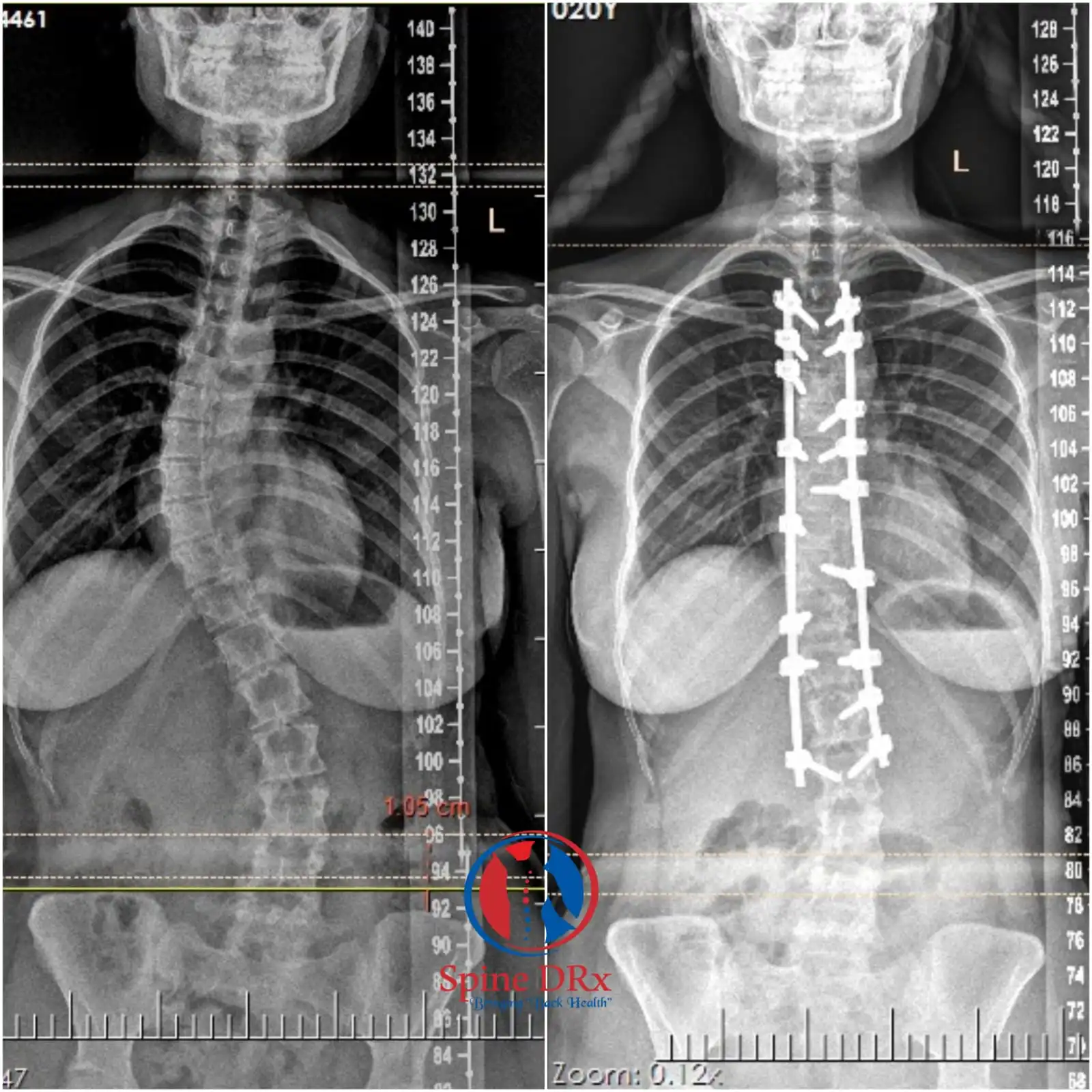
- Extensive experience in complex spinal deformity correction — including scoliosis, kyphosis, ankylosing spondylitis, flat-back syndrome, post-traumatic and post-infective deformities
- Full osteotomy repertoire — SPO / Ponte, PSO, and VCR — with selection based on precise analysis of each patient's deformity rather than surgical preference
- Meticulous pre-operative planning — full sagittal and coronal balance analysis, personalised correction goal-setting
- Mandatory intraoperative neurophysiological monitoring (IONM) for all osteotomy procedures — real-time spinal cord protection
- Intraoperative wake-up testing as an additional safety measure for major corrections
- Experienced neuro-anaesthesia team at Aster Whitefield Hospital
- Multidisciplinary support — cardiology, pulmonology, haematology input for complex cases
- Transparent, thorough informed consent — patients understand exactly what to expect
- Dedicated post-operative physiotherapy and rehabilitation planning
- Long-term follow-up — monitoring fusion, implants, and correction over years
- Safe Spine Surgery protocol — rigorous safety standards across every stage of care
FAQs
Spinal osteotomy surgery is a procedure in which one or more vertebral bones are surgically cut, partially removed, or repositioned to correct an abnormal spinal curvature or alignment. It is used to treat severe, rigid deformities including kyphosis, scoliosis, flat-back syndrome, and ankylosing spondylitis. The corrected spine is then stabilised with pedicle screws, rods, and bone grafting. There are three main types: Smith-Peterson/Ponte osteotomy, Pedicle Subtraction Osteotomy (PSO), and Vertebral Column Resection (VCR). Smith-Peterson (Ponte) osteotomy removes only posterior spinal elements and corrects approximately 10–15 degrees per level; it is suited for moderate, flexible deformities. Pedicle Subtraction Osteotomy (PSO) removes posterior elements plus a wedge of the vertebral body and can correct 25–40 degrees at one level; it is the standard for rigid single-apex deformities. Vertebral Column Resection (VCR) removes the entire vertebra and adjacent discs, achieving corrections of 40–80+ degrees; it is reserved for the most extreme, rigid deformities. Spinal osteotomy surgery is indicated for patients with severe, rigid spinal deformities that cause significant functional impairment and cannot be managed with non-surgical treatment. Common indications include: rigid kyphosis (Scheuermann's, post-traumatic, post-infectious), severe scoliosis exceeding 45–50 degrees that is rigid or progressing, ankylosing spondylitis with fixed chin-on-chest deformity, flat-back syndrome after previous spine surgery, and fixed sagittal imbalance. Each case is evaluated individually by Dr. Ramachandran. Spinal osteotomy surgery is a complex, major procedure with real risks — including neurological injury, blood loss, implant failure, and infection. However, in experienced hands with appropriate planning and monitoring, it is performed safely and can be genuinely life-transforming for patients who have been living with severe deformity. At SpineDRX, Dr. Ramachandran uses mandatory intraoperative neurophysiological monitoring (IONM), intraoperative wake-up testing, and the Safe Spine Surgery protocol to maximise safety at every stage. Recovery varies by the type of osteotomy performed. Most patients spend 7–14 days in hospital. Return to light daily activities is typically at 6–8 weeks. Return to desk work is usually possible at 8–12 weeks. Return to physical work or sport takes 9–12 months following confirmation of solid fusion. A spinal brace is prescribed for 3–6 months in most cases. Full bony fusion is confirmed by CT scan at 12 months. Flat-back syndrome is a condition where the normal inward (lordotic) curvature of the lumbar spine is lost — often as a complication of previous spinal fusion surgery. The patient is unable to stand fully upright without leaning forward, causing severe fatigue, back pain, and functional disability. Pedicle Subtraction Osteotomy (PSO) at the lumbar spine is the most effective surgical treatment, restoring lumbar lordosis and sagittal balance. Yes — for patients with ankylosing spondylitis who have developed a severe, fixed chin-on-chest deformity, PSO at the lumbar spine can dramatically restore the ability to stand upright and look ahead. This can be truly life-changing — patients who could not look forward while walking, could not see their food while eating, or could not drive are able to resume normal daily activities following successful PSO. The surgery is carefully planned with full sagittal balance analysis. IONM involves continuous real-time recording of electrical signals from the spinal cord and nerve roots throughout surgery — specifically somatosensory evoked potentials (SSEPs) and motor evoked potentials (MEPs). Any change in these signals alerts the surgical team to potential nerve or spinal cord compromise before permanent injury occurs, allowing immediate corrective action. IONM is mandatory for all osteotomy procedures at SpineDRX and is one of the most important safety measures in complex spinal deformity surgery. The number of fusion levels depends on the extent and location of the deformity. A focal osteotomy for flat-back syndrome may fuse as few as 3–5 levels. Major deformity corrections for severe scoliosis or kyphosis may require fusion across 10–15 or more levels. The fusion extent is carefully planned to include all deformed levels, achieve stable correction, and avoid unbalanced loading at adjacent unfused segments. Book an appointment online at spinedrx.com/contact-us, or call 7996997989 for the Kasavanahalli clinic or 7996992919 for the Whitefield clinic. Dr. Ram consults on Tuesday, Thursday, and Saturday evenings at Kasavanahalli, and Monday, Wednesday, and Friday evenings at Whitefield. Hospital consultations at Aster Whitefield are available all days except Sunday, 9 am to 5 pm. Please bring all available imaging (X-rays, MRI, CT) and any prior surgical reports.What is spinal osteotomy surgery?
What is the difference between Smith-Peterson, PSO, and VCR osteotomy?
Who needs spinal osteotomy surgery?
Is spinal osteotomy surgery safe?
How long does recovery take after spinal osteotomy surgery?
What is flat-back syndrome and can it be treated with osteotomy?
Can spinal osteotomy help ankylosing spondylitis patients?
What is intraoperative neurophysiological monitoring (IONM) and why is it important?
How many levels are fused during spinal osteotomy surgery?
How do I book a consultation for spinal osteotomy surgery at SpineDRX Bangalore?
Book Your Spinal Osteotomy Consultation in Bangalore — SpineDRX
Severe spinal deformity does not have to define your life. Whether you are struggling with the stooped posture of advanced kyphosis, the progressive curve of scoliosis, the rigid spine of ankylosing spondylitis, or the debilitating lean of flat-back syndrome — spinal osteotomy surgery in Bangalore at Spine DRx offers the possibility of meaningful, lasting correction. Dr. Ramachandran will assess your deformity with precision, explain your surgical options clearly, and — if surgery is the right choice — plan and perform the procedure with the highest standards of safety and technical excellence.