
Spinal Tumor Treatment in Bangalore — Multidisciplinary Expertise at SpineDRX
A spinal tumor diagnosis can be overwhelming. Questions crowd the mind — What type of tumour is it? How serious is it? What are the treatment options? Will surgery be needed? At SpineDRX, we understand that patients and families facing a spinal tumour need more than medical expertise — they need clarity, compassion, and a team they can trust.
Dr. Ramachandran Govindasamy, an experienced spine surgeon at SpineDRX, Bangalore, leads a dedicated multidisciplinary tumour board to deliver the highest standard of spinal tumor treatment in Bangalore. From precise diagnosis and biopsy to surgical resection, radiation planning, and oncology coordination, every patient receives a personalised, comprehensive care plan built around their specific tumour type, location, and overall health.
SpineDRX's clinics in Whitefield and Kasavanahalli, and surgical facilities at Aster Whitefield Hospital, make world-class spinal tumour care accessible across Bangalore.
What Is a Spinal Tumour?
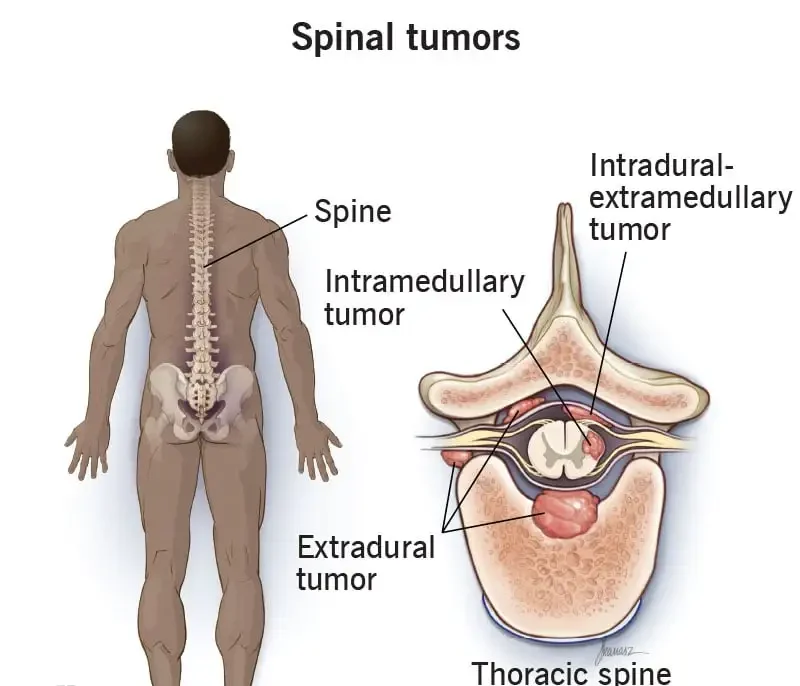
A spinal tumour is an abnormal mass of tissue that grows within or around the spinal column. Tumours can arise from the bones of the spine (vertebrae), the spinal cord itself, the nerves branching from the cord, the meninges (membranes covering the cord), or the surrounding soft tissues such as muscles and ligaments.
Spinal tumours are broadly classified in two major ways: by their origin (primary versus secondary/metastatic) and by their anatomical location within the spinal column.
Classification of Spinal Tumours
By origin — primary versus secondary tumours
| Primary Spinal Tumours | Secondary (Metastatic) Spinal Tumours |
|---|---|
| Originate within the spine itself from bone, nerve, or spinal cord tissue. | Spread (metastasise) to the spine from a tumour located elsewhere in the body. |
| Less common and may be benign or malignant. | More common; the spine is one of the most frequent sites of cancer spread. |
| Examples: Haemangioma, Schwannoma, Ependymoma, Chordoma, Osteosarcoma. | Examples: Breast cancer, lung cancer, prostate cancer, renal cell carcinoma, multiple myeloma. |
Primary Spinal Tumours — Types Treated at SpineDRX
Extradural (Bony / Epidural) Primary Tumours
- Haemangioma — benign vascular tumour, most common primary spinal tumour; often incidental but can cause pain or fracture
- Osteochondroma — benign bony outgrowth, typically in younger patients
- Osteoblastoma & Osteoid Osteoma — benign bone-forming tumours, commonly causing night pain; osteoid osteoma is often treated with radiofrequency ablation
- Aneurysmal Bone Cyst (ABC) — benign but locally aggressive; can cause vertebral instability
- Giant Cell Tumour (GCT) — locally aggressive; may recur; requires careful surgical planning
- Chordoma — rare, slow-growing malignant tumour arising from remnants of the notochord; typically at sacrum or clivus; requires wide resection
- Osteosarcoma — primary malignant bone tumour; requires neoadjuvant chemotherapy followed by surgery
- Ewing Sarcoma — aggressive malignancy in younger patients; treated with combined chemotherapy, radiation, and surgery
Intradural Primary Tumours
- Schwannoma — benign tumour arising from the nerve sheath (Schwann cells); most common intradural spinal tumour; highly curable with surgical excision
- Neurofibroma — nerve sheath tumour, may be associated with neurofibromatosis; surgical resection is the primary treatment
- Meningioma — benign tumour of the spinal meninges; more common in middle-aged women; excellent surgical outcomes
- Ependymoma — most common intramedullary tumour in adults; arises from ependymal cells lining the central canal; surgical resection is the goal
- Glioma / Astrocytoma — intramedullary tumours arising from glial cells; treatment is complex, requiring microsurgical technique
- Glioblastoma — rare but aggressive intramedullary tumour
- Haemangioblastoma — vascular intramedullary tumour, may be associated with von Hippel-Lindau syndrome
Secondary (Metastatic) Spinal Tumours — The Most Common Type
Metastatic spinal tumours are far more common than primary tumours. The spine is the most frequent site of skeletal metastasis — cancers from distant organs spread via the bloodstream to the vertebral bodies, and occasionally to the epidural space, compressing the spinal cord or nerve roots.
Common primary cancers that metastasise to the spine include:
| Cancer Type | Frequency of Spinal Metastasis | Typical Presentation |
|---|---|---|
| Breast carcinoma | Very common | Mid or lower back pain, vertebral collapse |
| Lung carcinoma | Very common | Rapid onset pain, cord compression |
| Prostate carcinoma | Very common (especially in men) | Lower back pain, sacral pain |
| Renal cell carcinoma | Common | Highly vascular lesion; bleeding risk at surgery |
| Multiple myeloma / Plasmacytoma | Common | Vertebral fractures, diffuse bone pain |
| Thyroid carcinoma | Moderate | Often solitary, well-defined lesion |
| Hepatocellular carcinoma | Moderate | Aggressive course, poor prognosis |
| Lymphoma | Moderate | Epidural involvement; often responds to radiation |
Symptoms of a Spinal Tumour — What to Watch For
Symptoms of a spinal tumour depend on its type, location, and rate of growth. Because many early symptoms overlap with common conditions like back pain or disc herniation, a high degree of clinical suspicion is essential — particularly in patients with a history of cancer or persistent unexplained pain.
Common Symptoms
- Persistent neck or back pain — often described as a deep, aching pain that is worse at night or at rest (unlike mechanical back pain, which typically improves with rest)
- Pain that does not respond to conventional back pain treatments
- Radiating pain — pain spreading to the arms, chest, abdomen, or legs depending on the tumour's spinal level
- Unexplained weight loss — a classic red-flag symptom suggesting underlying malignancy
- Fatigue and general malaise
- Fever without obvious infection — may indicate tumour-related inflammation or spinal infection
Neurological Symptoms (Indicating Nerve or Cord Compression)
- Weakness in the arms or legs — may be progressive
- Numbness or tingling in the limbs
- Difficulty walking or coordination problems (myelopathy)
- Muscle spasms or increased muscle tone (spasticity)
- Loss of bladder or bowel control — a medical emergency requiring urgent evaluation
- Scoliosis or spinal deformity — particularly in children or younger patients with primary tumours
Note: Progressive neurological weakness, loss of bladder or bowel function, or rapidly worsening pain in a patient with known cancer requires immediate specialist evaluation. Delay can result in permanent paralysis.
SpineDRX — Multidisciplinary Care for Every Patient
Spinal tumour treatment is among the most complex in all of spine care. No single specialist working alone can provide optimal outcomes — it requires a coordinated team with complementary expertise. This is why Dr. Ramachandran assembles a dedicated spinal tumour board for every patient presenting with a suspected or confirmed spinal tumour.
The SpineDRX tumour board brings together:
- Spine surgeon (Dr. Ramachandran Govindasamy) — leads surgical planning and coordination of care
- Neurosurgeon — for intramedullary and complex intradural tumour surgery
- Interventional musculoskeletal radiologist — for diagnostic biopsy and pre-operative embolisation of vascular tumours (particularly renal cell carcinoma metastases)
- Medical oncologist — for chemotherapy, targeted therapy, and monoclonal antibody treatment planning
- Radiation therapist / radiation oncologist — for radiotherapy, stereotactic radiosurgery (SRS), and SBRT planning
- Spine tumour pathologist — for tumour tissue diagnosis and molecular profiling
- Reconstructive plastic surgeon — for complex cases requiring soft tissue reconstruction alongside spinal surgery
- Palliative care specialist — for patients with advanced metastatic disease, focusing on pain control and quality of life
Every case is discussed at the tumour board before a treatment plan is finalised. This collaborative decision-making process ensures that every patient in Bangalore receives internationally benchmarked, personalised spinal tumor treatment.
Why Choose SpineDRX for Spinal Tumor Treatment in Bangalore?
- Experienced spine surgeon with specific expertise in both primary and metastatic spinal tumours
- Dedicated multidisciplinary tumour board — every case reviewed by a full team before treatment is initiated
- Internationally benchmarked treatment protocols — surgical, oncological, and radiotherapeutic
- Access to advanced surgical technology including intraoperative neurophysiological monitoring (IONM) for cord-level tumour surgery
- Collaborative network with leading oncologists, neurosurgeons, and radiation therapists in Bangalore
- Compassionate, transparent communication — Dr. Ram ensures patients and families fully understand the diagnosis, treatment options, and prognosis
- Surgical care at Aster Whitefield Hospital — a fully equipped multi-specialty facility
- Two clinic locations in Bangalore — Kasavanahalli and Whitefield — for convenient access
- Focus on quality of life — not just treating the tumour but preserving neurological function, mobility, and dignity
FAQs
A spinal tumour is an abnormal growth of tissue within or around the spinal column. Tumours can arise from the vertebral bones, spinal cord, nerve roots, or surrounding tissues (primary tumours), or they can spread to the spine from cancers originating in other organs such as the breast, lung, prostate, or kidney (secondary or metastatic tumours). Metastatic spinal tumours are more common than primary ones. Key warning signs of a spinal tumour include: persistent back or neck pain that is worse at night or at rest and does not respond to conventional treatment; unexplained weight loss; progressive weakness, numbness, or tingling in the arms or legs; difficulty walking or loss of coordination; and loss of bladder or bowel control. Any of these symptoms — particularly in a patient with a history of cancer — require immediate specialist evaluation. Whether a spinal tumour can be cured depends on its type, whether it is benign or malignant, and how early it is detected. Many benign primary tumours — such as schwannomas, meningiomas, and ependymomas — can be completely cured with surgical resection. Malignant primary tumours require a combination of surgery, radiation, and chemotherapy. Metastatic spinal tumours are generally not curable, but treatment can control the disease, relieve pain, restore or preserve neurological function, and significantly improve quality of life. A primary spinal tumour originates from the cells of the spine itself — the vertebral bones, spinal cord, nerve sheaths, or meninges. A secondary (metastatic) spinal tumour has spread to the spine from a cancer originating elsewhere in the body, such as the breast, lung, prostate, or kidney. Secondary tumours are far more common. Treatment strategies differ significantly between the two types. Diagnosis of a spinal tumour at SpineDRX involves: MRI of the spine with contrast (the primary imaging modality), CT scan for bony detail, whole-body PET-CT to detect the primary tumour and other metastases in suspected secondary cases, blood tests including tumour markers (CEA, CA-125, PSA, M-protein, Bence-Jones protein), and tissue biopsy when imaging alone is not conclusive. The complete workup is designed to determine tumour type, extent, and optimal treatment. Surgery is recommended for a spinal tumour when: (1) the tumour is causing spinal cord or nerve root compression with neurological symptoms (weakness, numbness, loss of bladder/bowel control); (2) the tumour is causing spinal instability or vertebral fracture; (3) tissue biopsy is needed for diagnosis; (4) the tumour is a resectable primary benign tumour (schwannoma, meningioma, ependymoma) or a primary malignant tumour requiring en-bloc resection; or (5) surgical stabilisation is needed to restore or maintain quality of life in metastatic disease. Dr. Ramachandran assembles a dedicated spinal tumour board for every patient with a confirmed or suspected spinal tumour. This board includes a spine surgeon, neurosurgeon, interventional radiologist, medical oncologist, radiation oncologist, spine tumour pathologist, and reconstructive surgeon. The team reviews each case together before finalising a treatment plan — ensuring every patient receives the most comprehensive, coordinated care available for spinal tumor treatment in Bangalore. Not necessarily. Spinal tumours can be benign (non-cancerous) or malignant (cancerous). Benign spinal tumours — such as haemangiomas, schwannomas, and meningiomas — do not invade surrounding tissues or spread to other parts of the body. Malignant spinal tumours (spinal cancer) — including osteosarcoma, chordoma, and metastatic deposits — can invade and spread. However, even benign tumours can be serious if they compress the spinal cord or destabilise the spine. Radiation therapy is used in several ways for spinal tumour treatment: as primary treatment for radiosensitive tumours such as lymphoma and myeloma; as adjuvant treatment after surgery to destroy residual tumour cells; as stereotactic radiosurgery (SRS/SBRT) for precise treatment of metastatic deposits and radio-resistant tumours; and as palliative treatment to relieve pain and prevent neurological deterioration in advanced metastatic disease. You can book an appointment online at spinedrx.com/contact-us, or call 7996997989 for the Kasavanahalli clinic or 7996992919 for the Whitefield clinic. Dr. Ram consults on Tuesday, Thursday, and Saturday evenings at Kasavanahalli, and Monday, Wednesday, and Friday evenings at Whitefield. Hospital consultations at Aster Whitefield are available all days except Sunday, 9 am to 5 pm. If you are experiencing progressive neurological symptoms, please seek urgent care.What is a spinal tumour?
What are the warning signs of a spinal tumour?
Can a spinal tumour be cured?
What is the difference between a primary and a secondary spinal tumour?
What investigations are done to diagnose a spinal tumour?
When is surgery needed for a spinal tumour?
What is the multidisciplinary tumour board at SpineDRX?
Is a spinal tumour the same as spinal cancer?
What is the role of radiation therapy in spinal tumour treatment?
How do I book an appointment for spinal tumour treatment at SpineDRX Bangalore?
Book Your Consultation — Spinal Tumor Specialist in Bangalore
A spinal tumour diagnosis demands prompt, expert, multidisciplinary attention. Whether you are dealing with a newly diagnosed spinal tumour, seeking a second opinion, or experiencing worsening back pain with a history of cancer, Dr. Ramachandran and the SpineDRX team are here to help.
You will receive an accurate diagnosis, a clear explanation of your options, and a personalised treatment plan — developed with the full expertise of a dedicated multidisciplinary tumour board, right here in Bangalore.