
Robotic Spine Surgery with ExcelsiusGPS
Robotic Spine Surgery in Bangalore with ExcelsiusGPS®
SpineDRX, under the leadership of Dr. Ramachandran, successfully performed a complex robotic-assisted scoliosis surgery at Aster Whitefield Hospital, Bangalore, using the ExcelsiusGPS® robotic navigation and guidance system. Bringing sub-millimeter surgical precision to complex spinal deformity correction in Bangalore.
Robotic Scoliosis Surgery at Aster Whitefield
Robotic Screw Placement Accuracy
Levels Instrumented in This Case
%
Real-Time Intraoperative CT Guidance
What is ExcelsiusGPS® robotic spine surgery?
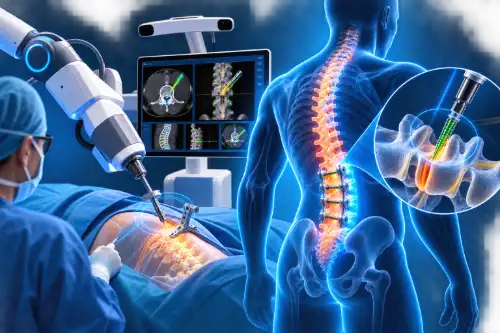
ExcelsiusGPS® is a robotic navigation platform that combines real-time intraoperative CT imaging with robotic-guided instrumentation. It is India's first system equipped to support both complex cranial and spinal procedures on a single platform, giving the surgical team a live, three-dimensional map of the spine throughout the operation.
Rather than replacing the surgeon's judgement, the robot acts as an extension of the surgeon's hand — holding a planned trajectory rigidly steady while pedicle screws are placed, so every implant lands exactly where it was planned, even in spines distorted by severe scoliosis or kyphosis.
Precision that matters most in the hardest cases
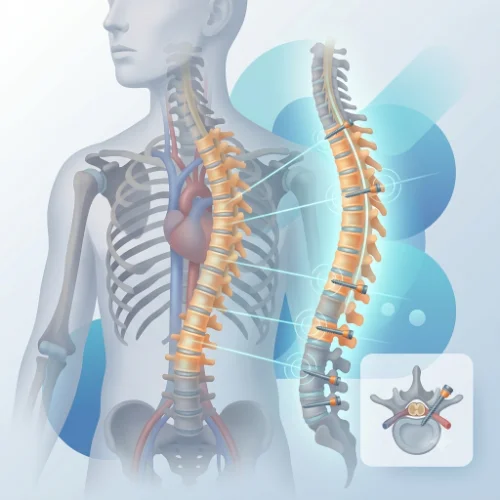
In deformities with a rigid rib hump or severely rotated vertebrae, freehand or fluoroscopy-guided screw placement carries a higher margin for error. Robotic guidance narrows that margin to sub-millimeter accuracy — critical when instrumentation runs close to the spinal cord and major vessels across many levels, as in extensive thoracolumbar fusions.
For patients, that translates into a more predictable correction, a safer operation, and — because the plan is executed exactly as designed — often a smoother, faster recovery.
Why robotic guidance changes the equation
Sub-millimeter accuracy
Every screw trajectory is planned in 3D and held rigidly by the robotic arm during placement.
Real-time CT navigation
Intraoperative CT keeps the surgical plan matched to the patient's exact anatomy throughout the case.
Reduced radiation exposure
Navigated placement reduces repeated fluoroscopy compared with conventional freehand techniques.
Shorter operating time
Pre-planned trajectories speed up instrumentation in long, multi-level fusions.
Less soft-tissue disruption
Accurate, minimally invasive placement supports a smoother, faster recovery.
Personalised 3D surgical mapping
Each patient's correction is planned on their own anatomy before a single screw is placed.
Conditions Treated
When robotic spine surgery is recommended
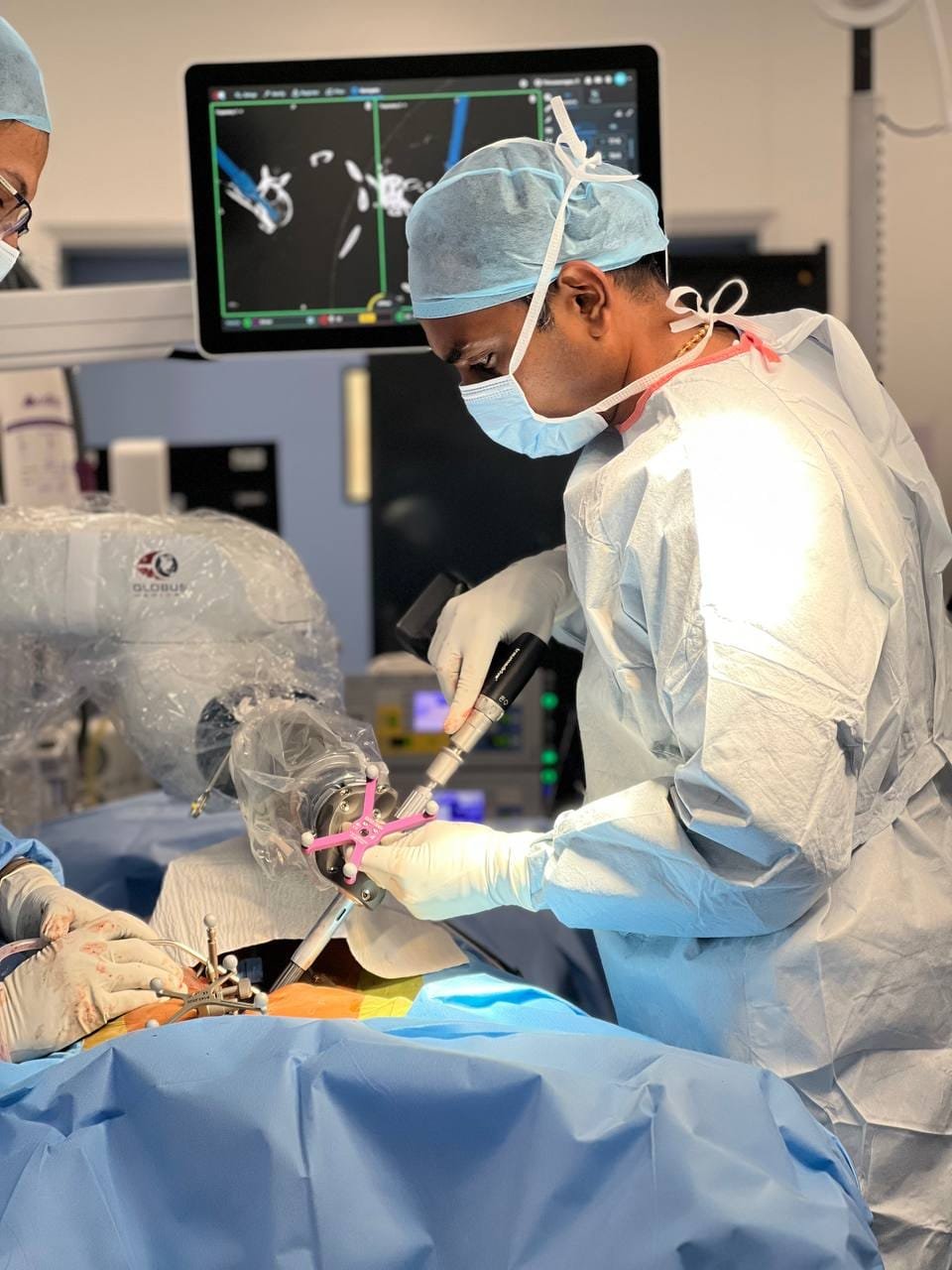
"Complex spinal conditions like scoliosis and severe kyphosis require meticulous evaluation, personalised care and top-tier expertise. Robotic guidance doesn't replace that judgement — it lets us execute it with a level of precision that wasn't possible before."
— Dr. Ramachandran Govindasamy, Consultant Spine & Deformity Surgeon, SpineDRX
FAQs
Yes. Robotic guidance is designed to increase safety, not introduce risk — it improves the accuracy of screw placement using real-time CT imaging, and the surgeon remains in full control throughout the procedure. Traditional freehand or fluoroscopy-guided techniques rely on the surgeon's real-time judgement of 2D imaging. ExcelsiusGPS® adds a 3D, real-time CT-guided robotic arm that holds each planned screw trajectory precisely in place, which is especially valuable in severely rotated or deformed spines. Yes — scoliosis and kyphoscoliosis, particularly rigid deformities with a rib hump, are among the cases that benefit most from robotic guidance, since precise, multi-level instrumentation is central to a safe correction. Recovery depends on the extent of the fusion and the patient's overall health. Because robotic placement is precise and often less disruptive to surrounding tissue, many patients experience a smoother early recovery than with conventional instrumentation — your surgeon will give you a personalised recovery timeline. Candidacy depends on your specific diagnosis, deformity severity and overall health. The best way to find out is a detailed evaluation with Dr. Ramachandran Govindasamy at SpineDRX.Is robotic spine surgery safe?
How is ExcelsiusGPS® different from traditional spine surgery?
Is robotic surgery suitable for scoliosis correction?
How long is the recovery after robotic-assisted spinal fusion?
Am I a candidate for robotic spine surgery?